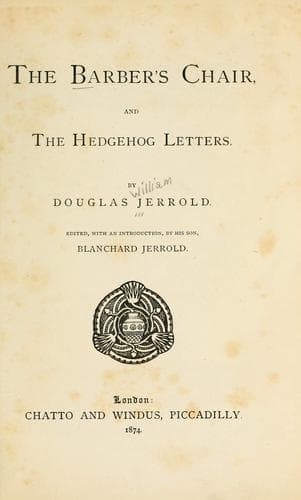
The barber's chair; and, The hedgehog lettersJerrold, Douglas William
General
The barber's chair; and, The hedgehog letters
Jerrold, Douglas William
English literature -- 19th century; English wit and humor
DEAR ISAAC,--I don’t know whether Portsmouth has any aldermen, but if
it has, I hope you’ll get into a gown outright. The thing’s as good as
done. What poor George the Third, Lord Eldon, and such folk think of
it, there’s no saying, but in a twinkling a Jew may be an alderman!
Even the Bishop of London swallows the measure, although shuddering at
it, as if it was a black draught. However, Isaac, what I write to you
about is this. Mr Ashurst, in the common council of London, spoke about
the Jews; and after him the Duke of Cambridge in the House of Lords.
Both of ’em gave their reasons for what is called Hebrew emancipation;
and droll it is to consider ’em one with the other. Here they are:--
MR ASHURST.
“No man was consulted as to who should be his parents; what
constitution, organisation, or temperament he should receive;
what should be his climate, his colour, or country; what should
be his language; what literature should influence him; what
education he should receive; nor as to what general external
circumstances should surround him. They saw and knew as a fact
_that religion was geographical_. If a man was born in Turkey,
he was a Mahometan; in Africa, a pagan; in India, he was one of
the multitudinous castes of sects which prevailed there; and in
a Christian country a Christian. Why, then, for a matter _which
was independent to himself_, should man lose in civil rights?
That religion which was true would ultimately prevail, but not
by persecution.”
DUKE OF CAMBRIDGE.
“I have had occasion for some time to know the good which
persons professing the Jewish religion have done; and
particularly with reference to the different charities to which
I belong; and I can certainly say that it is to them that we
owe a great deal, _and that they contribute_ a very large
portion to _the funds_ of the charities over which I have
the honour of presiding. Two of the individuals whose names
were mentioned in the speech of my noble and learned friend,
on a former occasion, are personally known to myself. One was
formerly the High Sheriff of the county of Kent--Mr Solomons;
and I can bear witness to the good he has done. Also there
Sir Moses Montefiore, ... learning what was the object of the
meeting I was about to attend, _he gave me a very handsome
sum_, which he desired me to present. I will not mention what
the sum was, for it would be a violation of good taste to do
so.”
Public-domain text, read in full here on John Shaqi.
Reviews
Reviews
No reviews yet
Be the first to share your thoughts on this work.
Elsewhere in the archive
Join the Discussion
Join the discussion
Sign in to leave a comment or review.
Sign InorCreate an account