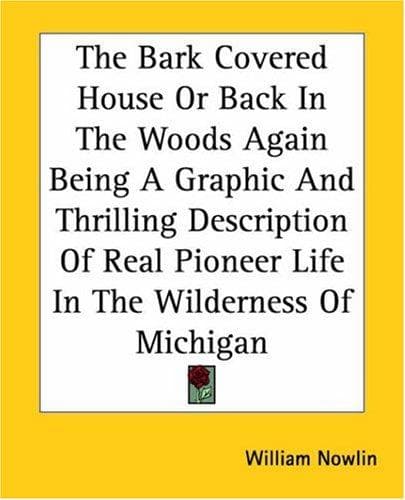
The Bark Covered House: Or, Back In the Woods Again; Being a Graphic and Thrilling Description of Real Pioneer Life in the Wilderness of MichiganNowlin, William
History
The Bark Covered House: Or, Back In the Woods Again; Being a Graphic and Thrilling Description of Real Pioneer Life in the Wilderness of Michigan
Nowlin, William
Dearborn (Mich.); Frontier and pioneer life -- Michigan -- Dearborn
Among the annoyances common to man and beast in Michigan, of which we
knew nothing where we came from, were some enormous flies. There were two
kinds that were terrible pests to the cattle. They actually ate the hide
off, in spots. First we put turpentine, mixed with sufficient grease so
as not to take the hair off, on those spots. But we found that fish oil
was better, the flies would not bite where that was.
What we called the ox-flies were the most troublesome. In hot weather and
in the sun, where the mosquitoes didn't trouble, they were most numerous.
They would light on the oxen in swarms, on their brisket, and between
their legs where they could not drive them off. I have frequently struck
these flies with my hand and by killing them got my hand red with the
blood of the ox.
The other species of flies, we called Pontiacers. This is a Michigan
name, and originated I was told, from one being caught near Pontiac with
a paper tied or attached to it having the word Pontiac written upon it.
These flies were not very numerous; sometimes there were three or four
around at once. When they were coming we could hear and see them for some
rods. Their fashion was to circle around the oxen before lighting on
them. I frequently slapped them to kill them, sometimes I caught them, in
that case they were apt to lose their heads, proboscis and all. These
flies were very large, some were black and some of the largest were
whitish on the front of the back. I have seen some of them nearly as
large as young humming birds. The Germans tell me they have this kind of
fly in Germany. But with the mosquitoes, these flies have nearly
disappeared.
CHAPTER VIII.
HARD TIMES FOR US IN MICHIGAN, 1836-7.
The oxen having worked hard and been used to good hay, which we bought
for them, grew poor when they were fed on marsh hay. Then Mr. Blare
wanted to sell his part to father; then the cattle would not have so much
to do. Father was not able to buy them, as his money was nearly gone. He
said he would mortgage his lot for one hundred dollars, buy them back,
buy another cow and have a little money to use.
He said he could do his spring's work with the cattle, then turn them
off, fatten them, and sell them in the fall for enough to pay the
mortgage. Mother said all she could to prevent it, for she could not bear
the idea of having her home mortgaged. It seemed actually awful to me,
for I thought we should not be able to pay it, and in all probability we
should lose the place. I said all I could, but to no avail. The whole
family was alarmed; one of the small children asked mother what a
mortgage was, she replied that it was something that would take our home
away from us, if not paid.
Public-domain text, read in full here on John Shaqi.
Reviews
Reviews
No reviews yet
Be the first to share your thoughts on this work.
Join the Discussion
Join the discussion
Sign in to leave a comment or review.
Sign InorCreate an account