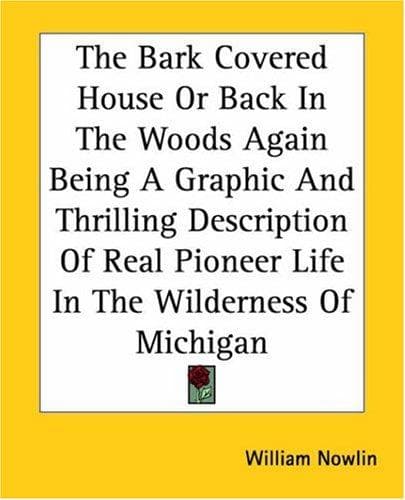
The Bark Covered House: Or, Back In the Woods Again; Being a Graphic and Thrilling Description of Real Pioneer Life in the Wilderness of Michigan — John Shaqi
The Bark Covered House: Or, Back In the Woods Again; Being a Graphic and Thrilling Description of Real Pioneer Life in the Wilderness of MichiganNowlin, William
History
The Bark Covered House: Or, Back In the Woods Again; Being a Graphic and Thrilling Description of Real Pioneer Life in the Wilderness of Michigan
Nowlin, William
Dearborn (Mich.); Frontier and pioneer life -- Michigan -- Dearborn
We still had wheat but sometimes had to almost do without groceries. We
always had something to eat but sometimes our living was very poor.
Sometimes we had potatoes and milk and sometimes thickened milk. This was
made by dampening flour, rolling it into fine lumps and putting them into
boiling milk with a little salt, and stirring it until it boiled again.
This was much more palatable than potatoes and milk.
One afternoon two neighbors' girls came to visit us. They stayed late.
After they went away I asked mother why she didn't give them some tea;
she said she had no tea to give them, and that if she had given them the
best she had they would have gone away and told how poor we were.
Mother had been used to better days and to treating her guests well, and
her early life in Michigan did not take all of her spirit away. She was a
little proud as well as I, but I have learned that pride, hard times and
poverty are very poor companions. It was no consolation to think that the
neighbors, most of them, were as bad off as we were. This made the thing
still worse.
CHAPTER IX.
A SUMMER HUNT.
Father and I went hunting one day. I took my shot-gun, loaded with half a
charge of shot and three rifle bullets, which just chambered in the
barrel, so I thought I was ready to shoot at anything. Father went ahead
and I followed him; we walked very carefully in the woods looking for
deer; went upon a sand ridge where father saw a deer and shot at it. I
recollect well how it looked; it was a beautiful deer, almost as red as a
cherry. After he shot, it stood still. I asked father, in a whisper, if I
might not shoot. He said, "Keep still!" (I had very hard word to do so,
and think if he had let me shot, I should have given it a very loud call,
at least, I think I should have killed it.) Father loaded his rifle and
shot again. The last time he shot, the deer ran away. We went to the
place where it had stood. He had hit it for we found a little blood; but
it got away.
It is said "the leopard cannot change his spots nor the Ethiopian his
skin," but the deer, assisted by nature, can change both his color and
his hide. In summer the deer is red, and the young deer are covered with
beautiful spots which disappear by fall. The hair of the deer is short in
summer and his hide is thick. At this time the hide is most valuable by
the pound. His horns grow and form their prongs, when growing we call
them in their velvet; feel of them and they are soft, through the summer
and fall, and they keep growing until they form a perfect horn, hard as a
bone. By the prongs we are able to tell the number of years old they are.
Public-domain text, read in full here on John Shaqi.
Reviews
Reviews
No reviews yet
Be the first to share your thoughts on this work.
Join the Discussion
Join the discussion
Sign in to leave a comment or review.
Sign InorCreate an account