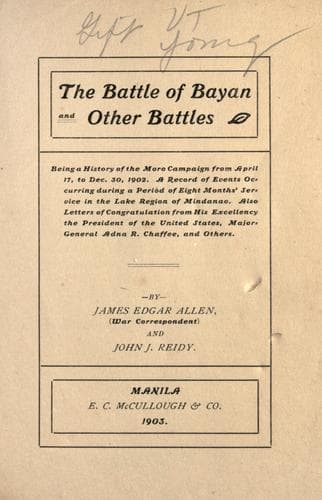
The Battle of Bayan and Other BattlesAllen, James Edgar
History
The Battle of Bayan and Other Battles
Allen, James Edgar
Philippines -- History -- 1898-1946; United States. Army -- History
The Americans, seeing that the restoration of peace in the island of
Mindanao could not be brought about by fair and honorable means,
decided to administer a lesson to them that they would not very readily
forget.
HOSTILITIES RENEWED.
An expedition was organized on short notice, commanded by Capt. J. J.
Pershing, of the 15th Regiment of Cavalry, a man whose never failing
courage, valor, and ability as an officer and commander is unexcelled in
the American Army.
Every preparation was made for the coming events, and on September 17,
at midnight, what was known as Captain Pershing's expedition left Camp
Vicars under cover of darkness and proceeded through rugged trails to
Maciu's strongholds and neighboring principalities.
The expedition consisted of Companies "F," "G," "C," and "M" of the 27th
Infantry; Troop "L" 15th Regiment of Cavalry; and the 25th Battery of
Field Artillery.
On the morning of the 18th, as the first refulgent beams of "Old Sol"
had begun to illuminate the eastern horizon, the column had reached and
halted close by Fort Gauan, and ere another hour had elapsed the entire
fortification was surrounded by our troops.
The 25th Battery had halted directly in front of, and about 300 yards
from, the fort, while companies "M" and "F," "G" and "C" had formed
skirmish lines on the left and right of the fort. The command was given
for the first shot to be fired and everybody waited in silent expectancy
for the outcome. In an instant there was a flash, and "bang" went the
projectile with lightning velocity, hitting the outer breastworks of
the enclosure, from which rose vast clouds of smoke and fragments.
The firing from the fort was rapid at first, but gradually diminished as
the outer bombardment continued, and finally ceased altogether, for the
Artillery onslaught had been terrible while it lasted, and nothing
remained of that once impregnable fortress save a few shattered walls,
with here and there the mangled corpse of a dead Moro.
The day was gradually drawing to a close, which made it necessary for us
to establish a temporary camp for the night.
This was done, and very fortunately, adjacent to a small river, which
proved to be a great convenience to both men and animals.
Natives fired frequently into the midst of the camp, but fortunately
without any serious casualty to the Americans. The first faint glimmer
of dawn that broke over the eastern hill-tops found us again in
readiness and, after partaking of a hurried breakfast, we broke camp and
again took up the trail, this time in the direction of Bayubao.
BAYUBAO VANQUISHED.
The trails were, in a great many places, almost impassable, making
marching with equipments very laborious. However, we arrived at Bayubao
about 2 p.m. and rested for refreshments on the top of a high hill,
which over-looked the fort and the unruffled waters of Lake Lanao.
Public-domain text, read in full here on John Shaqi.
Reviews
Reviews
No reviews yet
Be the first to share your thoughts on this work.
Join the Discussion
Join the discussion
Sign in to leave a comment or review.
Sign InorCreate an account