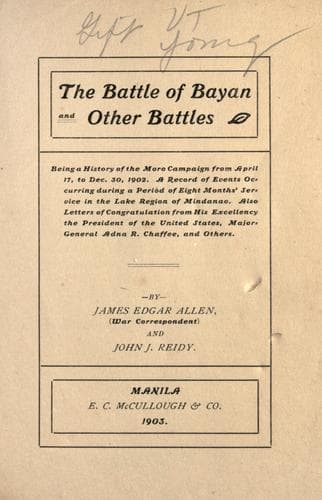
The Battle of Bayan and Other BattlesAllen, James Edgar
History
The Battle of Bayan and Other Battles
Allen, James Edgar
Philippines -- History -- 1898-1946; United States. Army -- History
And since then the broad road to civilization has been opened to the
hitherto savage Moro tribes, and chiefly by the brave officers and men
of the 27th Regiment.
And in conclusion we can only say that the memories of the true, loyal,
and ever dauntless heroes of this new, though historical regiment, who
gave and sacrificed their lives in the defence of, and for the glory of,
their country, shall be indelibly printed on the tablets of our memories
adown the annals of time.
JOHN J. REIDY.
THE 25TH BATTERY OF FIELD ARTILLERY.
Under the Army Reorganization Bill, passed in 1900, provision was made
for an increase in the number of Field Batteries, three of which were to
be equipped entirely with mountain guns. These were to be known as the
14th, 25th, and 28th Batteries of Field Artillery. Two of these
Batteries were to be organized in the Philippine Islands. These were the
14th and 25th, and were organized by equally dividing the number of
members in what was formerly known as Light Battery "C" of the 7th
Artillery.
The two Batteries were given their authorized strength of 120 men each
by transferring the additional number of men required from the Coast
Artillery.
They were not organized, however, until Sept. 23, 1901. About one month
later they were fully equipped as "Mountain Batteries," and on April 1,
1902, the 25th Battery, under command of Captain W. S. McNair, was
ordered to the Island of Mindanao, where trouble with the Moros had long
been expected.
The 25th Battery of Field Artillery is equipped with four guns, which
are known as the Vickers-Maxim 75 mm. quick firing mountain guns.
This calibre, 75 mm., or 2.9 inches, will be seen to be a very little
less than that of the field gun in use in our service viz., 3.2 inches,
but the power of this gun is much less than that of the field gun, for
the following reasons:
It is necessary to make a carriage and gun whose parts shall all be
within suitable limits of weight for packing on mules. This limit,
placed on the weight, limits the strength that can be obtained, and also
the length of the gun itself. Therefore the amount of powder used in
these guns is much less than the amount used in the field guns, and the
velocity of the shot when it leaves the gun is much less (about
one-half) than it is for the field gun. The Vickers-Maxim gun is mounted
in a cradle which has on either side a cylinder of oil, through which
the gun draws a plunger in recoiling, and by this device the force of
the recoil is taken up gradually and the carriage does not run back
several feet as it would otherwise do, so that it is at once ready to
load and fire again after each discharge.
Public-domain text, read in full here on John Shaqi.
Reviews
Reviews
No reviews yet
Be the first to share your thoughts on this work.
Join the Discussion
Join the discussion
Sign in to leave a comment or review.
Sign InorCreate an account