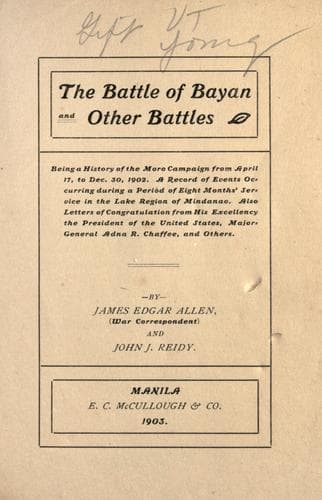
The Battle of Bayan and Other BattlesAllen, James Edgar
History
The Battle of Bayan and Other Battles
Allen, James Edgar
Philippines -- History -- 1898-1946; United States. Army -- History
At daylight camp was broken, and the column pushed ahead in the
direction of Bayan.
The column was halted about one half mile from the first fort.
The Moro outposts opened fire on the Americans, but they were not
replied to.
The Americans were waiting for twelve o'clock.
About one thousand yards to the right and front was a small clump of
bamboo, several natives appeared there, firing a few shots and
flourishing their weapons, all the time yelling like mad.
It was now plainly seen that the Moros were determined to have war.
The Artillery was brought into play and trained on the clump of bamboo
on the right, also Fort Binidayan, which was situated on the crest of a
high hill about fifteen hundred yards distant.
Those were indeed moments of suspense for those gallant troops, but not
a shot was fired by them, although they were under an almost constant
fire from the enemy.
HOSTILITIES BEGIN.
But just at twelve o'clock, General Davis stepped forward, watch in
hand, and took one long, lingering look in the direction of Fort
Binidayan, and then, not seeing any signs of a peace envoy, but, on the
contrary, every indication of hostility, he turned slowly to Captain W.
S. McNair, of the 25th Battery, and gave the signal to "let her go."
"Boom," echoed the little mountain guns, and away went a shrapnel
screaming across the open and just three and six-tenths seconds after,
exploded immediately over the fort.
Instantly figures were seen hurrying to and fro about the fort.
"Boom!" went another, this time at the clump of bamboo on the right.
A puff of smoke, and then,--a cloud of dust immediately in front of the
bamboo--told the tale only too well to the gunners.
The battle of the Bayan forts had begun.
Quick movements were observed here and there, companies were being
assigned their positions, orders were being transmitted like lightning
from point to point, and in less time than it takes to narrate it, that
body of men were swung into action like the pendulum of a clock.
DESTRUCTION OF BINIDAYAN.
The work of demolishing the Binidayan Fort had now begun in earnest,
companies "F" and "G" of the 27th Infantry advanced in line of
skirmishers, while the Artillery continued a slow fire on the Fort,
company "H" joined "F," and crossed the intervening ridge and then
through the little valley, while "G" went off to the right, to flank
Binidayan and at the same time to make a demonstration against Fort
Pandapatan, which was to the right and rear of Binidayan.
Fort Pandapatan was the second fort known as the system of Bayan forts,
of which there are four.
At the base of the Binidayan hill the Infantry halted for an instant,
and then started up the hill in a long, thin line of skirmishers, with
determination written in their faces.
It was the initial event of the kind for many of them, but every head
was erect, every man in his place.
There was not a bit of confusion, simply an orderly line of men coming
up to do battle.
Public-domain text, read in full here on John Shaqi.
Reviews
Reviews
No reviews yet
Be the first to share your thoughts on this work.
Join the Discussion
Join the discussion
Sign in to leave a comment or review.
Sign InorCreate an account