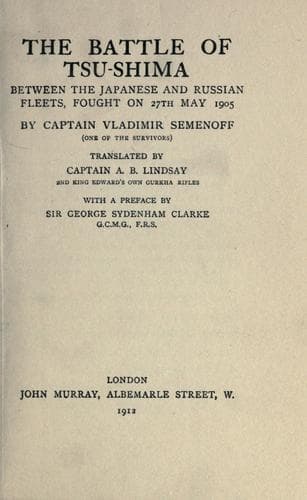
The Battle of Tsu-shima: between the Japanese and Russian fleets, fought on 27th May 1905 — John Shaqi
The Battle of Tsu-shima: between the Japanese and Russian fleets, fought on 27th May 1905Semenov, V. I. (Vladimir Ivanovich)
History
The Battle of Tsu-shima: between the Japanese and Russian fleets, fought on 27th May 1905
Semenov, V. I. (Vladimir Ivanovich)
Russo-Japanese War, 1904-1905 -- Naval operations; Tsushima, Battle of, 1905
It should be stated that V. V. Ignatzius, in the first place, was one
of those who was firmly convinced that the success of our voyage--this
desperate adventure--depended solely on the extent of co-operation
of Saint Nicolas “The Casual” and other heavenly powers, and, in the
second place, bearing in mind the Japanese custom of concentrating
their fire on the flag-ship, he believed that both he and his ship
were doomed to destruction in the first decisive engagement. But, in
spite of this, he never for a moment lost his invariably buoyant and
cheery manner. He joked, chaffed, and eagerly threw himself into all
the little details of daily life on board, while now (I really believe)
he was, inwardly, much amused, picturing to himself the anger and
disappointment of the Japanese in the event of our actually slipping
past them.
But the Japanese “got the 200,000th chance,” and more.
At dawn on 27th May, about 5 A.M., the auxiliary cruiser _Sinano Maru_
almost ran into our hospital ships, and it was due to this that the
whole fleet was discovered. We were unable to see what had happened,
but by the changed character of the messages it became at once apparent
that our presence was known. The scouts no longer merely called each
other up, and we now took in reports, which were being transmitted
further and further to the north.[11]
Messages came in from both sides, so the Admiral recalled the _Almaz_,
_Svietlana_ and _Ural_, in order to protect our helpless rear
(transports) from sudden attack.
About 6 A.M. the _Ural_ came up at full speed, reporting by semaphore
that astern of the fleet four ships, which it was impossible to
recognise in the mist, were crossing from starboard to port.
At 6.45 A.M. a vessel appeared on the starboard beam, which, as her
course brought her nearer to us, was soon recognised as the _Idzumi_.
About 8 A.M., despite the mist, we were able to take her distance as
10,000 yards. The alarm sounding, the after turret threateningly raised
her 12-inch guns, but the _Idzumi_, guessing her danger, commenced
rapidly to beat a retreat.
We might, of course, have detached a good cruiser to drive her off,
but alas! there were in the fleet only two ships answering to this
description--the _Oleg_ and the _Aurora_, also possibly the scout
_Svietlana_; of the remainder, the _Donskoy_ and _Monomakh_ were
respectable veterans, slow, though passably armed. The _Ural_ and
_Almaz_ were swift, but had only toy guns. Besides, each moment we
were expecting to meet our formidable opponent, when every gun and
shell would be of value. If the issue of the battle were to be decided
by a duel between our three armoured squadrons and the twelve best
Japanese ships, the whole of the rest of the enemy’s fleet would fall
to the lot of our cruiser squadron. A struggle for which we must indeed
reserve our strength! Rozhdestvensky decided accordingly to ignore the
_Idzumi’s_ daring sally, and sent no one in pursuit of her.
Public-domain text, read in full here on John Shaqi.
Reviews
Reviews
No reviews yet
Be the first to share your thoughts on this work.
Join the Discussion
Join the discussion
Sign in to leave a comment or review.
Sign InorCreate an account