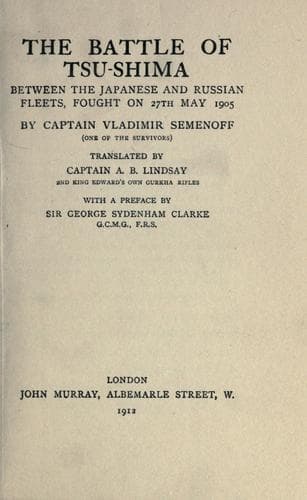
The Battle of Tsu-shima: between the Japanese and Russian fleets, fought on 27th May 1905Semenov, V. I. (Vladimir Ivanovich)
History
The Battle of Tsu-shima: between the Japanese and Russian fleets, fought on 27th May 1905
Semenov, V. I. (Vladimir Ivanovich)
Russo-Japanese War, 1904-1905 -- Naval operations; Tsushima, Battle of, 1905
On 10th August, in a fight lasting some hours, the _Cesarevitch_ was
struck by only nineteen large shells, and I, in all seriousness, had
intended in the present engagement to note the times and the places
where we were hit, as well as the damage done. But how could I make
detailed notes when it seemed impossible even to count the number of
projectiles striking us? I had not only never witnessed such a fire
before, but I had never imagined anything like it. Shells seemed to be
pouring upon us incessantly, one after another.[15]
After six months with the Port Arthur squadron I had grown indifferent
to most things. Shimose and melinite were to a certain extent old
acquaintances, but this was something new. It seemed as if these were
mines, not shells, which were striking the ship’s side and falling
on the deck. They burst as soon as they touched anything--the moment
they encountered the least impediment in their flight. Handrails,
funnel guys, topping lifts of the boats’ derricks, were quite
sufficient to cause a thoroughly efficient burst. The steel plates and
superstructure on the upper deck were torn to pieces, and the splinters
caused many casualties. Iron ladders were crumpled up into rings, and
guns were literally hurled from their mountings.
Such havoc would never be caused by the simple impact of a shell, still
less by that of its splinters. It could only be caused by the force of
the explosion. The Japanese had apparently succeeded in realising what
the Americans had endeavoured to attain in inventing their “Vesuvium.”
In addition to this, there was the unusual high temperature and liquid
flame of the explosion, which seemed to spread over everything. I
actually watched a steel plate catch fire from a burst. Of course,
the steel did not burn, but the paint on it did. Such almost
non-combustible materials as hammocks, and rows of boxes, drenched
with water, flared up in a moment. At times it was impossible to see
anything with glasses, owing to everything being so distorted with the
quivering, heated air. No! It was different to the 10th August![16]
I hurriedly went to the Admiral in the conning tower. Why? At the time
I did not attempt to think, but now feel sure that I merely wished
to see him, and by seeing him to confirm my impressions. Was it all
imagination? Was it all a nightmare? Had I become jumpy?
Running along the fore-bridge I almost fell, slipping in a pool of
blood (the chief signalman--Kandaooroff--had just been killed there).
I went into the conning tower, and found the Admiral and Captain both
bending down, looking out through the chink between the armour and the
roof.
“Sir,” said the Captain, energetically gesticulating as was his wont,
“we must shorten the distance. They’re all being killed--they are on
fire!”
“Wait a bit. Aren’t we all being killed also?” replied the Admiral.
Close to the wheel, and on either side of it, lay two bodies in
officers’ tunics--face downwards.
Public-domain text, read in full here on John Shaqi.
Reviews
Reviews
No reviews yet
Be the first to share your thoughts on this work.
Join the Discussion
Join the discussion
Sign in to leave a comment or review.
Sign InorCreate an account