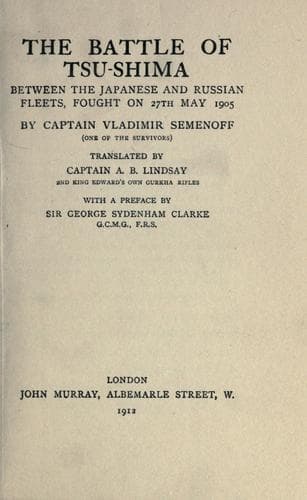
The Battle of Tsu-shima: between the Japanese and Russian fleets, fought on 27th May 1905Semenov, V. I. (Vladimir Ivanovich)
History
The Battle of Tsu-shima: between the Japanese and Russian fleets, fought on 27th May 1905
Semenov, V. I. (Vladimir Ivanovich)
Russo-Japanese War, 1904-1905 -- Naval operations; Tsushima, Battle of, 1905
“Can you manage to go? Stop--I’ll tell off some one to go with you,”
said Danchich, making what seemed to me an unnecessary fuss.
I was annoyed, and angrily said: “Who wants to be accompanied?” and
bravely started to go down the ladder, not realising what had happened.
When a small splinter had wounded me in the waist at the beginning of
the fight, it had hurt me; but this time I felt nothing.
Later, in the hospital, when carried there on a stretcher, I understood
why it is that during a fight one hears neither groans nor shouts. All
that comes afterwards. Apparently our feelings have strict limits
for receiving external impressions, being even deeply impressed by an
absurd sentence. A thing can be so painful that you feel nothing, so
terrible that you fear nothing.
Having passed through the upper and lower batteries, I descended
to the mess deck (under the armoured one), to the hospital, but I
involuntarily went back to the ladder.
The mess deck was full of wounded.[23] They were standing, sitting,
lying--some on mattresses put ready beforehand--some on hastily spread
tarpaulins--some on stretchers--some just anyhow. Here it was that they
first began to feel. The dreadful noise of deep sighs and half-stifled
groans was audible in the close, damp air, which smelt of something
sour and disgustingly sickly. The electric light seemed scarcely able
to penetrate this stench. Ahead somewhere, in white coats stained with
red splotches, busy figures were moving about, and towards them all
these piles of flesh, clothes, and bones turned, and in their agony
dragged themselves, expecting something from them. It seemed as if a
cry, motionless, voiceless, but intelligible, a cry which reached to
one’s very soul, a request for help, for a miracle, for relief from
suffering--though at the price of a speedy death--rose up on all sides.
I did not stop to wait my turn, and, not wishing to put myself before
others, quickly went up the ladder to the lower battery, where I met
the Flag Captain, who had his head bandaged. (He had been wounded in
the back of the neck by three splinters.)
On enquiry I learned that at the same time as the steering gear had
been injured and the flag-ship had left her place, the Admiral and
Vladimirsky were wounded in the head in the conning tower. The latter
had gone below to get his wounds dressed, and had been succeeded in
command by Bogdanoff, the third lieutenant. The Admiral’s orders were
to steer after the fleet.
Public-domain text, read in full here on John Shaqi.
Reviews
Reviews
No reviews yet
Be the first to share your thoughts on this work.
Join the Discussion
Join the discussion
Sign in to leave a comment or review.
Sign InorCreate an account