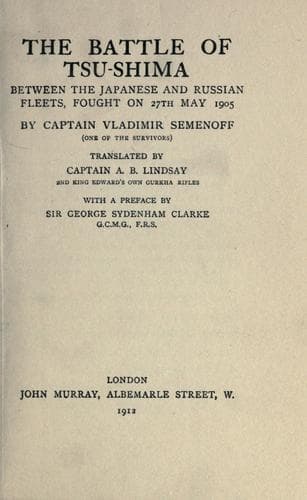
The Battle of Tsu-shima: between the Japanese and Russian fleets, fought on 27th May 1905Semenov, V. I. (Vladimir Ivanovich)
History
The Battle of Tsu-shima: between the Japanese and Russian fleets, fought on 27th May 1905
Semenov, V. I. (Vladimir Ivanovich)
Russo-Japanese War, 1904-1905 -- Naval operations; Tsushima, Battle of, 1905
[5] “Together” has a literal meaning: the ships all change direction
simultaneously to the same side and at the same angle. By doing this
they take up a new formation, parallel to their former line, and to
starboard or to port of it, moving ahead or not according to the size
of the angle of turning. Shortly after changing direction the order is
again given to turn “together” at the same angle, but to the opposite
side, and the ships thus find themselves once more in single column
line ahead, but at some distance to starboard or to port of their
original course.
“Together” is the direct opposite to “in succession,” when each ship
changes direction as she comes to the spot in which the leading ship
has turned--_i.e._ follows her.
[6] “Samotopy” literally “self-sinkers.”--A.B.L.
[7] Admiral Nebogatoff, with the 3rd squadron, joined the main fleet on
9th May.--A.B.L.
[8] A play upon the words. The Russian translation of “presentiment” is
“feeling before.”--A.B.L.
[9] Fate had not been kind to us. The _Terek_ and _Kuban_ met no one
all the time that they were there, and no one knew of their presence in
those waters.
[10] Verbatim in the context.--A.B.L.
[11] According to Japanese reports, Togo, who was stationed with his
main body somewhere off Fusan, was at this time in complete ignorance
of our whereabouts and was waiting for news from both north and south.
[12] A point = 11¼°.
[13] At Port Arthur the long Japanese shells of big calibre guns were
nicknamed (“chemodani”) “portmanteaus.” Indeed, what else could you
call a shell, a foot in diameter and more than 4 feet long, filled with
explosive?
[14] A flag-sub-lieutenant.
[15] Japanese officers said that after Port Arthur had capitulated,
while waiting for the Baltic fleet, they worked up to their high state
of preparation as follows:--At target practice every gun captain fired
five live shells out of his gun. New guns were afterwards substituted
for those worn out.
Public-domain text, read in full here on John Shaqi.
Reviews
Reviews
No reviews yet
Be the first to share your thoughts on this work.
Elsewhere in the archive
Join the Discussion
Join the discussion
Sign in to leave a comment or review.
Sign InorCreate an account