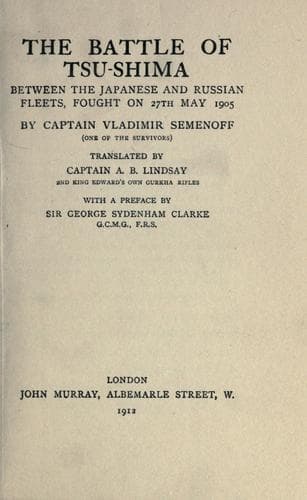
The Battle of Tsu-shima: between the Japanese and Russian fleets, fought on 27th May 1905Semenov, V. I. (Vladimir Ivanovich)
History
The Battle of Tsu-shima: between the Japanese and Russian fleets, fought on 27th May 1905
Semenov, V. I. (Vladimir Ivanovich)
Russo-Japanese War, 1904-1905 -- Naval operations; Tsushima, Battle of, 1905
[16] According to thoroughly trustworthy reports, the Japanese in the
battle of Tsu-shima were the first to employ a new kind of explosive
in their shells, the secret of which they bought during the war from
its inventor, a colonel in one of the South American Republics. It was
said that these shells could only be used in guns of large calibre in
the armoured squadrons, and that is how those of our ships engaged with
Admiral Kataoka’s squadron did not suffer the same amount of damage,
or have so many fires, as the ships engaged with the battleships and
armoured cruisers. Very convincing proofs of this were the cases of the
_Svietlana_ and _Donskoy_. On 28th May the former was subjected to the
fire of two light cruisers, and the latter to the fire of five. In the
first place, both were able to hold out for a considerable time, and
in the second (and this is most important), they did not catch fire,
although on both ships--the _Donskoy_, which was one of the older type,
and the _Svietlana_, which was like a yacht--there was considerably
more combustible material than on the newer type of battleship.
For a great many years in naval gunnery two distinct ideas have
prevailed--one is to inflict on the enemy, although not necessarily
much (in quantity), severe and heavy damage--_i.e._ to stop
movement--to penetrate under the water-line--to get a burst in the hull
below the water-line--briefly, to put the ship at once out of action.
The other is to pour upon him the greatest volume of fire in the
shortest time--though it be above water and the actual damage caused by
each individual shot be immaterial--in the hope of paralysing the ship,
trusting that if this were done it would not be difficult to destroy
her completely--that she would, in fact, sink by herself.
With modern guns, in order to secure the first of the above ideas,
solid armour-penetrating projectiles must be employed--_i.e._
thick-coated shells (whose internal capacity and bursting charge is
consequently diminished), and percussion fuzes with retarded action,
bursting the shell inside the target. To secure the second idea shells
need only be sufficiently solid to ensure their not bursting at the
moment of being fired. The thickness of their walls may be reduced to
the minimum, and their internal capacity and bursting charge increased
to the utmost limits. The percussion fuses should be sensitive enough
to detonate at the slightest touch.
The first of the above views prevails chiefly in France, the second in
England. In the late war we held the first, and the Japanese the second.
[17] A colonel of the marine artillery--flag gunnery officer.
[18] By the Admiral’s order the iron oil drums, instead of being thrown
away, had been converted into buckets, and these home-made contrivances
were placed about the decks.
[19] In the Battle of Tsu-shima the Japanese losses were:
Public-domain text, read in full here on John Shaqi.
Reviews
Reviews
No reviews yet
Be the first to share your thoughts on this work.
Elsewhere in the archive
Join the Discussion
Join the discussion
Sign in to leave a comment or review.
Sign InorCreate an account