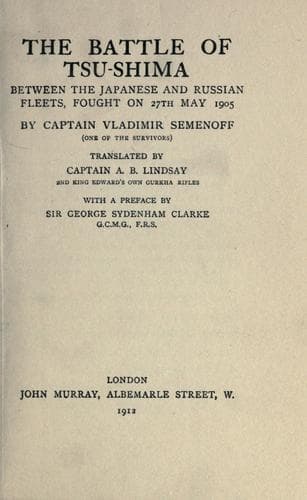
The Battle of Tsu-shima: between the Japanese and Russian fleets, fought on 27th May 1905Semenov, V. I. (Vladimir Ivanovich)
History
The Battle of Tsu-shima: between the Japanese and Russian fleets, fought on 27th May 1905
Semenov, V. I. (Vladimir Ivanovich)
Russo-Japanese War, 1904-1905 -- Naval operations; Tsushima, Battle of, 1905
Killed 113
Dangerously wounded 139
Severely wounded 243
Slightly wounded 42
These figures are sufficiently eloquent, even allowing for the reports
of Japanese officers to be somewhat partial. Almost half of the
casualties (252 out of 537) were killed and dangerously wounded, the
other half were severely and slightly wounded--less than 8 per cent.
The total number was insignificant. Our shells evidently either never
burst, or burst badly, _i.e._ in a few large pieces. The Japanese
bursting charge was seven times stronger than ours, and consisted not
of pyroxylene, but of shimose (and perhaps of something still more
powerful). Shimose, on exploding, raises the temperature one and a half
times higher than pyroxylene. In fact, one might say that a Japanese
shell bursting well did as much damage as twelve of ours bursting
equally well. And this ours rarely succeeded in doing!
[20] The ships nearest to us reported afterwards that the armoured
shield on our after turret had been blown right up above the bridges,
and then was seen to fall crumpled up on to the poop. What had actually
happened was not known.
[21] In order to establish a connection between the facts which I
personally saw and noted down, and in order to be able to explain
the Japanese movements, I shall have recourse to sources which can
hardly be suspected of partiality towards us. I refer to two Japanese
official publications which are both entitled “Nippon-Kai Tai-Kai-Sen”
(“The Great Battle in the Sea of Japan”). The books are illustrated by
a number of photographs and plans taken at different moments of the
fight, and contain the reports of various ships and detachments. A
few quite immaterial differences in description of detail by various
witnesses have not been removed, as they only give the stamp of truth
to the publication.
I must request my readers to excuse the heavy, and at times incoherent
language introduced by me in these quotations. The reason for this
is my wish to keep as near as possible to the original, and, in the
construction of its sentences, Japanese is totally different to any
European language.
[22] In a ship there is no proper church compartment. The church is
only rigged when a service is to be held.
[23] There were probably more here than in the whole of the Japanese
fleet.
[24] Whether this turn was intentional or accidental, owing to the
damage done to her steering communicators, will for ever remain a
secret.
[25] Courland is one of the Baltic Provinces where German is
spoken.--A.B.L.
Public-domain text, read in full here on John Shaqi.
Reviews
Reviews
No reviews yet
Be the first to share your thoughts on this work.
Elsewhere in the archive
Join the Discussion
Join the discussion
Sign in to leave a comment or review.
Sign InorCreate an account