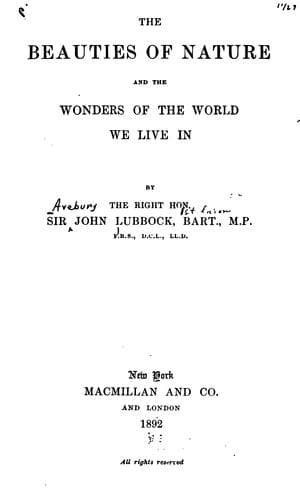
The Beauties of Nature, and the Wonders of the World We Live InLubbock, John, Sir
Philosophy
The Beauties of Nature, and the Wonders of the World We Live In
Lubbock, John, Sir
Astronomy; Natural history; Physical geography
Though Jefferies was unfortunately never able to travel, few men have
loved Nature more devotedly, and speaking of his own home he expresses
his opinion that: "Of all sweet things there is none so sweet as fresh
air--one great flower it is, drawn round about; over, and enclosing us,
like Aphrodite's arms; as if the dome of the sky were a bell-flower
drooping down over us, and the magical essence of it filling all the
room of the earth. Sweetest of all things is wild-flower air. Full of
their ideal the starry flowers strained upwards on the bank, striving to
keep above the rude grasses that push by them; genius has ever had such
a struggle. The plain road was made beautiful by the many thoughts it
gave. I came every morning to stay by the star-lit bank."
Passing to countries across the ocean, Humboldt tells us that: "If I
might be allowed to abandon myself to the recollection of my own distant
travels, I would instance, amongst the most striking scenes of nature,
the calm sublimity of a tropical night, when the stars, not sparkling,
as in our northern skies, shed their soft and planetary light over the
gently heaving ocean; or I would recall the deep valleys of the
Cordilleras, where the tall and slender palms pierce the leafy veil
around them, and waving on high their feathery and arrow-like branches,
form, as it were, 'a forest above a forest'; or I would describe the
summit of the Peak of Teneriffe, when a horizon layer of clouds,
dazzling in whiteness, has separated the cone of cinders from the plain
below, and suddenly the ascending current pierces the cloudy veil, so
that the eye of the traveller may range from the brink of the crater,
along the vine-clad slopes of Orotava, to the orange gardens and banana
groves that skirt the shore. In scenes like these, it is not the
peaceful charm uniformly spread over the face of nature that moves the
heart, but rather the peculiar physiognomy and conformation of the land,
the features of the landscape, the ever-varying outline of the clouds,
and their blending with the horizon of the sea, whether it lies spread
before us like a smooth and shining mirror, or is dimly seen through the
morning mist. All that the senses can but imperfectly comprehend, all
that is most awful in such romantic scenes of nature, may become a
source of enjoyment to man, by opening a wide field to the creative
power of his imagination. Impressions change with the varying movements
of the mind, and we are led by a happy illusion to believe that we
receive from the external world that with which we have ourselves
invested it."
Humboldt also singles out for especial praise the following description
given of Tahiti by Darwin[6]:--
Public-domain text, read in full here on John Shaqi.
Reviews
Reviews
No reviews yet
Be the first to share your thoughts on this work.
Join the Discussion
Join the discussion
Sign in to leave a comment or review.
Sign InorCreate an account