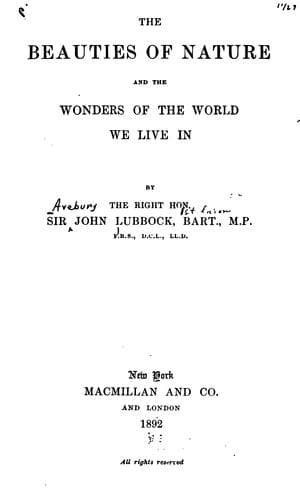
The Beauties of Nature, and the Wonders of the World We Live InLubbock, John, Sir
Philosophy
The Beauties of Nature, and the Wonders of the World We Live In
Lubbock, John, Sir
Astronomy; Natural history; Physical geography
"But indeed there are days," says Emerson, "which occur in this climate,
at almost any season of the year, wherein the world reaches its
perfection, when the air, the heavenly bodies, and the earth make a
harmony, as if nature would indulge her offspring.... These halcyon days
may be looked for with a little more assurance in that pure October
weather, which we distinguish by the name of the Indian summer. The day,
immeasurably long, sleeps over the broad hills and warm wide fields. To
have lived through all its sunny hours, seems longevity enough." Yet
does not the very name of Indian summer imply the superiority of the
summer itself,--the real, the true summer, "when the young corn is
bursting into ear; the awned heads of rye, wheat, and barley, and the
nodding panicles of oats, shoot from their green and glaucous stems, in
broad, level, and waving expanses of present beauty and future promise.
The very waters are strewn with flowers: the buck-bean, the
water-violet, the elegant flowering rush, and the queen of the waters,
the pure and splendid white lily, invest every stream and lonely mere
with grace."[9]
For our greater power of perceiving, and therefore of enjoying Nature,
we are greatly indebted to Science. Over and above what is visible to
the unaided eye, the two magic tubes, the telescope and microscope, have
revealed to us, at least partially, the infinitely great and the
infinitely little.
Science, our Fairy Godmother, will, unless we perversely reject her
help, and refuse her gifts, so richly endow us, that fewer hours of
labour will serve to supply us with the material necessaries of life,
leaving us more time to ourselves, more leisure to enjoy all that makes
life best worth living.
Even now we all have some leisure, and for it we cannot be too grateful.
"If any one," says Seneca, "gave you a few acres, you would say that you
had received a benefit; can you deny that the boundless extent of the
earth is a benefit? If a house were given you, bright with marble, its
roof beautifully painted with colours and gilding, you would call it no
small benefit. God has built for you a mansion that fears no fire or
ruin ... covered with a roof which glitters in one fashion by day, and
in another by night. Whence comes the breath which you draw; the light
by which you perform the actions of your life? the blood by which your
life is maintained? the meat by which your hunger is appeased?... The
true God has planted, not a few oxen, but all the herds on their
pastures throughout the world, and furnished food to all the flocks; he
has ordained the alternation of summer and winter ... he has invented so
many arts and varieties of voice, so many notes to make music.... We
have implanted in us the seeds of all ages, of all arts; and God our
Master brings forth our intellects from obscurity."[10]
FOOTNOTES:
[1] _Choses Vues._
[2] Wordsworth.
[3] Cicero, _De Natura Deorum_.
[4] Thoreau.
[5] Spenser.
[6] Darwin's _Voyage of the Beagle_.
Public-domain text, read in full here on John Shaqi.
Reviews
Reviews
No reviews yet
Be the first to share your thoughts on this work.
Join the Discussion
Join the discussion
Sign in to leave a comment or review.
Sign InorCreate an account