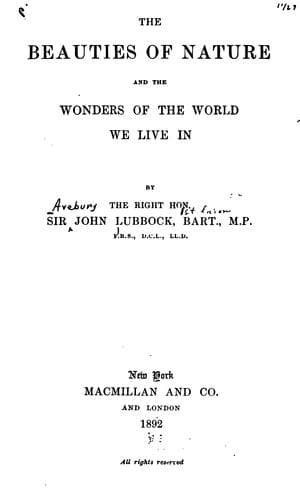
The Beauties of Nature, and the Wonders of the World We Live InLubbock, John, Sir
Philosophy
The Beauties of Nature, and the Wonders of the World We Live In
Lubbock, John, Sir
Astronomy; Natural history; Physical geography
Some animals may delight us especially by their beauty, such as birds or
butterflies; others may surprise us by their size, as Elephants and
Whales, or the still more marvellous monsters of ancient times; may
fascinate us by their exquisite forms, such as many microscopic shells;
or compel our reluctant attention by their similarity to us in
structure; but none offer more points of interest than those which live
in communities. I do not allude to the temporary assemblages of
Starlings, Swallows, and other birds at certain times of year, nor even
to the permanent associations of animals brought together by common
wants in suitable localities, but to regular and more or less organised
associations. Such colonies as those of Rooks and Beavers have no doubt
interesting revelations and surprises in store for us, but they have not
been as yet so much studied as those of some insects. Among these the
Hive Bees, from the beauty and regularity of their cells, from their
utility to man, and from the debt we owe them for their unconscious
agency in the improvement of flowers, hold a very high place; but they
are probably less intelligent, and their relations with other animals
and with one another are less complex than in the case of Ants, which
have been so well studied by Gould, Huber, Forel, M'Cook, and other
naturalists.
The subject is a wide one, for there are at least a thousand species of
Ants, no two of which have the same habits. In this country we have
rather more than thirty, most of which I have kept in confinement. Their
life is comparatively long: I have had working Ants which were seven
years old, and a Queen Ant lived in one of my nests for fifteen years.
The community consists, in addition to the young, of males, which do no
work, of wingless workers, and one or more Queen mothers, who have at
first wings, which, however, after one Marriage flight, they throw off,
as they never leave the nest again, and in it wings would of course be
useless. The workers do not, except occasionally, lay eggs, but carry on
all the affairs of the community. Some of them, and especially the
younger ones, remain in the nest, excavate chambers and tunnels, and
tend the young, which are sorted up according to age, so that my nests
often had the appearance of a school, with the children arranged in
classes.
Public-domain text, read in full here on John Shaqi.
Reviews
Reviews
No reviews yet
Be the first to share your thoughts on this work.
Join the Discussion
Join the discussion
Sign in to leave a comment or review.
Sign InorCreate an account