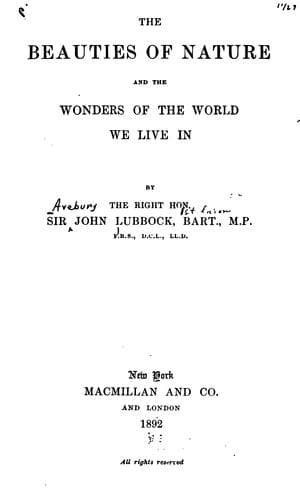
The Beauties of Nature, and the Wonders of the World We Live In — John Shaqi
The Beauties of Nature, and the Wonders of the World We Live InLubbock, John, Sir
Philosophy
The Beauties of Nature, and the Wonders of the World We Live In
Lubbock, John, Sir
Astronomy; Natural history; Physical geography
We constantly speak of animals as free. A fish, says Ruskin, "is much
freer than a Man; and as to a fly, it is a black incarnation of
freedom." It is pleasant to think of anything as free, but in this case
the idea is, I fear, to a great extent erroneous. Young animals may
frolic and play, but older ones take life very seriously. About the
habits of fish and flies, indeed, as yet we know very little. Any one,
however, who will watch animals will soon satisfy himself how diligently
they work. Even when they seem to be idling over flowers, or wandering
aimlessly about, they are in truth diligently seeking for food, or
collecting materials for nests. The industry of Bees is proverbial. When
collecting honey or pollen they often visit over twenty flowers in a
minute, keeping constantly to one species, without yielding a moment's
dalliance to any more sweet or lovely tempter. Ants fully deserve the
commendation of Solomon. Wasps have not the same reputation for
industry; but I have watched them from before four in the morning till
dark at night working like animated machines without a moment's rest or
intermission. Sundays and Bank Holidays are all the same to them. Again,
Birds have their own gardens and farms from which they do not wander,
and within which they will tolerate no interference. Their ideas of the
rights of property are far stricter than those of some statesmen. As to
freedom, they have their daily duties as much as a mechanic in a mill or
a clerk in an office. They suffer under alarms, moreover, from which we
are happily free. Mr. Galton believes that the life of wild animals is
very anxious. "From my own recollection," he says, "I believe that every
antelope in South Africa has to run for its life every one or two days
upon an average, and that he starts or gallops under the influence of a
false alarm many times in a day. Those who have crouched at night by the
side of pools in the desert, in order to have a shot at the beasts that
frequent it, see strange scenes of animal life; how the creatures gambol
at one moment and fight at another; how a herd suddenly halts in
strained attention, and then breaks into a maddened rush as one of them
becomes conscious of the stealthy movements or rank scent of a beast of
prey. Now this hourly life-and-death excitement is a keen delight to
most wild creatures, but must be peculiarly distracting to the
comfort-loving temperament of others. The latter are alone suited to
endure the crass habits and dull routine of domesticated life. Suppose
that an animal which has been captured and half-tamed, received
ill-usage from his captors, either as punishment or through mere
brutality, and that he rushed indignantly into the forest with his ribs
aching from blows and stones. If a comfort-loving animal, he will
probably be no gainer by the change, more serious alarms and no less
ill-usage awaits him: he hears the roar of the wild beasts, and the
Public-domain text, read in full here on John Shaqi.
Reviews
Reviews
No reviews yet
Be the first to share your thoughts on this work.
Join the Discussion
Join the discussion
Sign in to leave a comment or review.
Sign InorCreate an account