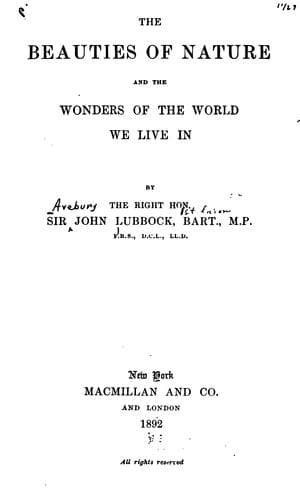
The Beauties of Nature, and the Wonders of the World We Live InLubbock, John, Sir
Philosophy
The Beauties of Nature, and the Wonders of the World We Live In
Lubbock, John, Sir
Astronomy; Natural history; Physical geography
We share with other animals the great blessing of Sleep, nature's soft
nurse, "the mantle that covers thought, the food that appeases hunger,
the drink that quenches thirst, the fire that warms cold, the cold that
moderates heat, the coin that purchases all things, the balance and
weight that equals the shepherd with the king, and the simple with the
wise." Some animals dream as we do; Dogs, for instance, evidently dream
of the chase. With the lower animals which cannot shut their eyes it is,
however, more difficult to make sure whether they are awake or asleep. I
have often noticed insects at night, even when it was warm and light,
behave just as if they were asleep, and take no notice of objects which
would certainly have startled them in the day. The same thing has also
been observed in the case of fish.
But why should we sleep? What a remarkable thing it is that one-third of
our life should be passed in unconsciousness. "Half of our days," says
Sir T. Browne, "we pass in the shadow of the earth, and the brother of
death extracteth a third part of our lives." The obvious suggestion is
that we require rest. But this does not fully meet the case. In sleep
the mind is still awake, and lives a life of its own: our thoughts
wander, uncontrolled, by the will. The mind, therefore, is not
necessarily itself at rest; and yet we all know how it is refreshed by
sleep.
But though animals sleep, many of them are nocturnal in their habits.
Humboldt gives a vivid description of night in a Brazilian forest.
"Everything passed tranquilly till eleven at night, and then a noise so
terrible arose in the neighbouring forest that it was almost impossible
to close our eyes. Amid the cries of so many wild beasts howling at once
the Indians discriminated such only as were (at intervals) heard
separately. These were the little soft cries of the sapajous, the moans
of the alouate apes, the howlings of the jaguar and couguar, the peccary
and the sloth, and the cries of (many) birds. When the jaguars
approached the skirt of the forest our dog, which till then had never
ceased barking, began to howl and seek for shelter beneath our hammocks.
Sometimes, after a long silence, the cry of the tiger came from the tops
of the trees; and then it was followed by the sharp and long whistling
of the monkeys, which appeared to flee from the danger which threatened
them. We heard the same noises repeated during the course of whole
months whenever the forest approached the bed of the river.
Public-domain text, read in full here on John Shaqi.
Reviews
Reviews
No reviews yet
Be the first to share your thoughts on this work.
Join the Discussion
Join the discussion
Sign in to leave a comment or review.
Sign InorCreate an account