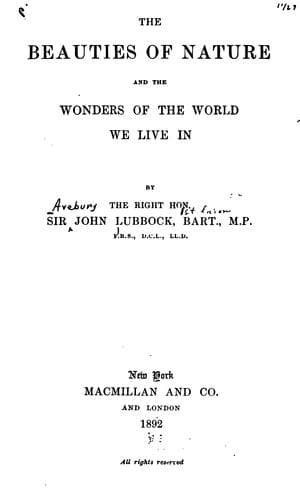
The Beauties of Nature, and the Wonders of the World We Live InLubbock, John, Sir
Philosophy
The Beauties of Nature, and the Wonders of the World We Live In
Lubbock, John, Sir
Astronomy; Natural history; Physical geography
Or take again the sense of Hearing. The vibrations of the air no doubt
play upon the drum of the ear, and the waves thus produced are conducted
through a complex chain of small bones to the fenestra ovalis and so to
the inner ear or labyrinth. But beyond this all is uncertainty. The
labyrinth consists mainly of two parts (1) the cochlea, and (2) the
semicircular canals, which are three in number, standing at right angles
to one another. It has been supposed that they enable us to maintain
the equilibrium of the body, but no satisfactory explanation of their
function has yet been given. In the cochlea, Corti discovered a
remarkable organ consisting of some four thousand complex arches, which
increase regularly in length and diminish in height. They are connected
at one end with the fibres of the auditory nerve, and Helmholtz has
suggested that the waves of sound play on them, like the fingers of a
performer on the keys of a piano, each separate arch corresponding to a
different sound. We thus obtain a glimpse, though but a glimpse, of the
manner in which perhaps we hear; but when we pass on to the senses of
smell and taste, all we know is that the extreme nerve fibres terminate
in certain cells which differ in form from those of the general surface;
but in what manner the innumerable differences of taste or smell are
communicated to the brain, we are absolutely ignorant.
If then we know so little about ourselves, no wonder that with reference
to other animals our ignorance is extreme.
We are too apt to suppose that the senses of animals must closely
resemble, and be confined to ours.
No one can doubt that the sensations of other animals differ in many
ways from ours. Their organs are sometimes constructed on different
principles, and situated in very unexpected places. There are animals
which have eyes on their backs, ears in their legs, and sing through
their sides.
We all know that the senses of animals are in many cases much more acute
than ours, as for instance the power of scent in the dog, of sight in
the eagle. Moreover, our eye is much more sensitive to some colours than
to others; least so to crimson, then successively to red, orange,
yellow, blue, and green; the sensitiveness for green being as much as
750 times as great as for red. This alone may make objects appear of
very different colours to different animals.
Public-domain text, read in full here on John Shaqi.
Reviews
Reviews
No reviews yet
Be the first to share your thoughts on this work.
Join the Discussion
Join the discussion
Sign in to leave a comment or review.
Sign InorCreate an account