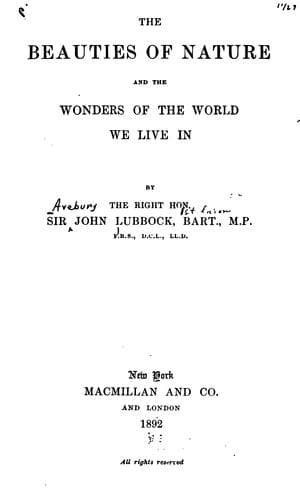
The Beauties of Nature, and the Wonders of the World We Live InLubbock, John, Sir
Philosophy
The Beauties of Nature, and the Wonders of the World We Live In
Lubbock, John, Sir
Astronomy; Natural history; Physical geography
Microscopic animals make up in number what they lack in size. Paris is
built of Infusoria. The Peninsula of Florida, 78,000 square miles in
extent, is entirely composed of coral debris and fragments of shells.
Chalk consists mainly of Foraminifera and fragments of shells deposited
in a deep sea. The number of shells required to make up a cubic inch is
almost incredible. Ehrenberg has estimated that of the Bilin polishing
slate which caps the mountain, and has a thickness of forty feet, a
cubic inch contains many hundred million shells of Infusoria.
In another respect these microscopic organisms are of vital importance.
Many diseases are now known, and others suspected, to be entirely due to
Bacteria and other minute forms of life (Microbes), which multiply
incredibly, and either destroy their victims, or after a while diminish
again in numbers. We live indeed in a cloud of Bacteria. At the
observatory of Montsouris at Paris it has been calculated that there are
about 80 in each cubic meter of air. Elsewhere, however, they are much
more numerous. Pasteur's researches on the Silkworm disease led him to
the discovery of Bacterium anthracis, the cause of splenic fever.
Microbes are present in persons suffering from cholera, typhus,
whooping-cough, measles, hydrophobia, etc., but as to their history and
connection with disease we have yet much to learn. It is fortunate,
indeed, that they do not all attack us.
In surgical cases, again, the danger of compound fractures and
mortification of wounds has been found to be mainly due to the presence
of microscopic organisms; and Lister, by his antiseptic treatment which
destroys these germs or prevents their access, has greatly diminished
the danger of operations, and the sufferings of recovery.
SIZE OF ANIMALS
In the size of animals we find every gradation from these atoms which
even in the most powerful microscopes appear as mere points, up to the
gigantic reptiles of past ages and the Whales of our present ocean. The
horned Ray or Skate is 25 feet in length, by 30 in width. The
Cuttle-fishes of our seas, though so hideous as to resemble a bad dream,
are too small to be formidable; but off the Newfoundland coast is a
species with arms sometimes 30 feet long, so as to be 60 feet from tip
to tip. The body, however, is small in proportion. The Giraffe attains a
height of over 20 feet; the Elephant, though not so tall, is more bulky;
the Crocodile reaches a length of over 20 feet, the Python of 60 feet,
the extinct Titanosaurus of the American Jurassic beds, the largest land
animal yet known to us, 100 feet in length and 30 in height; the
Whalebone Whale over 70 feet, Sibbald's Whale is said to have reached
80-90, which is perhaps the limit. Captain Scoresby indeed mentions a
Rorqual no less than 120 feet in length, but this is probably too great
an estimate.
COMPLEXITY OF ANIMAL STRUCTURE
Public-domain text, read in full here on John Shaqi.
Reviews
Reviews
No reviews yet
Be the first to share your thoughts on this work.
Join the Discussion
Join the discussion
Sign in to leave a comment or review.
Sign InorCreate an account