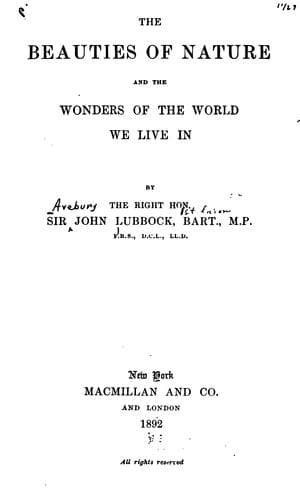
The Beauties of Nature, and the Wonders of the World We Live In — John Shaqi
The Beauties of Nature, and the Wonders of the World We Live InLubbock, John, Sir
Philosophy
The Beauties of Nature, and the Wonders of the World We Live In
Lubbock, John, Sir
Astronomy; Natural history; Physical geography
In other cases the leaves hold the rain or dew drops. Every one who has
been in the Alps must have noticed how the leaves of the Lady's Mantle
(Alchemilla) form little cups containing each a sparkling drop of icy
water. Kerner has suggested that owing to these cold drops, the cattle
and sheep avoid the leaves.
MIMICRY
In many cases plants mimic others which are better protected than
themselves. Thus Matricaria Chamomilla mimics the true Chamomile, which
from its bitterness is not eaten by quadrupeds. Ajuga Chamaepitys mimics
Euphorbia Cyparissias, with which it often grows, and which is protected
by its acrid juice. The most familiar case, however, is that of the
Stinging and the Dead Nettles. They very generally grow together, and
though belonging to quite different families are so similar that they
are constantly mistaken for one another. Some Orchids have a curious
resemblance to insects, after which they have accordingly been named the
Bee Orchis, Fly Orchis, Butterfly Orchis, etc., but it has not yet been
satisfactorily shown what advantage the resemblance is to the plant.
ANTS AND PLANTS
The transference of pollen from plant to plant is by no means the only
service which insects render.
Ants, for instance, are in many cases very useful to plants. They
destroy immense numbers of caterpillars and other insects. Forel
observing a large Ants' nest counted more than 28 insects brought in as
food per minute. In some cases Ants attach themselves to particular
trees, constituting a sort of bodyguard. A species of Acacia, described
by Belt, bears hollow thorns, while each leaflet produces honey in a
crater-formed gland at the base, as well as a small, sweet, pear-shaped
body at the tip. In consequence it is inhabited by myriads of a small
ant, which nests in the hollow thorns, and thus finds meat, drink, and
lodging all provided for it. These ants are continually roaming over the
plant, and constitute a most efficient bodyguard, not only driving off
the leaf-eating ants, but, in Belt's opinion, rendering the leaves less
liable to be eaten by herbivorous mammalia. Delpino mentions that on one
occasion he was gathering a flower of Clerodendrum, when he was himself
suddenly attacked by a whole army of small ants.
INSECTIVOROUS PLANTS
Public-domain text, read in full here on John Shaqi.
Reviews
Reviews
No reviews yet
Be the first to share your thoughts on this work.
Join the Discussion
Join the discussion
Sign in to leave a comment or review.
Sign InorCreate an account