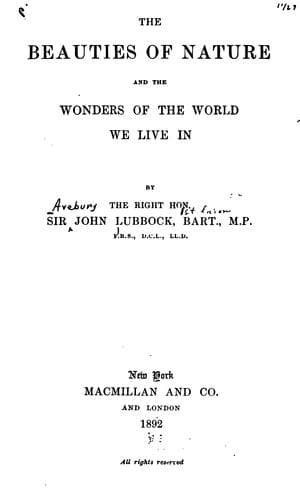
The Beauties of Nature, and the Wonders of the World We Live InLubbock, John, Sir
Philosophy
The Beauties of Nature, and the Wonders of the World We Live In
Lubbock, John, Sir
Astronomy; Natural history; Physical geography
The stream of lava which burst from Mouna Loa in 1885 had a length of 70
miles; that of Skaptar-Jokul in Iceland in 1783 had a length of 50
miles, and a maximum depth of nearly 500 feet. It has been calculated
that the mass of lava equalled that of Mont Blanc.
The stones, ashes, and mud ejected during eruptions are even more
destructive than the rivers of lava. In 1851 Tomboro, a volcano on the
Island of Sumbava, cost more lives than fell in the battle of Waterloo.
The earthquake of Lisbon in 1755 destroyed 60,000 persons. During the
earthquake of Riobamba and the mud eruption of Tunguragua, and again in
that of Krakatoa, it is estimated that the number who perished was
between 30,000 and 40,000. At the earthquake of Antioch in 526 no less
than 200,000 persons are said to have lost their lives.
Perhaps the most destructive eruption of modern times has been that on
Cosequina. For 25 miles it covered the ground with muddy water 16 feet
in depth. The dust and ashes formed a dense cloud, extending over many
miles, some of it being carried 20 degrees to the west. The total mass
ejected has been estimated at 60 milliards of square yards.
Stromboli, in the Mediterranean (Fig. 23), though only 2500 feet in
height, is very imposing from its superb regularity, and its roots
plunge below the surface to a depth of 4000 feet.
It is, moreover, very interesting from the regularity of its action,
which has a period of 5 minutes or a little less. On looking down into
the crater one sees at a depth of say 300 feet a seething mass of
red-hot lava; this gradually rises, and then explodes, throwing up a
cloud of vapour and stones, after which it sinks again. So regular is it
that the Volcano has been compared to a "flashing" lighthouse, and this
wonderful process has been going on for ages.
[Illustration: Fig. 23.--Stromboli, viewed from the north-west, April
1874.]
Though long extinct, volcanoes once existed in the British Isles;
Arthur's Seat, near Edinburgh, for instance, appears to be the funnel of
a small volcano, belonging to the Carboniferous period.
The summit of a volcanic mountain is sometimes entirely blown away.
Between my first two visits to Vesuvius 200 feet of the mountain had
thus disappeared. Vesuvius itself stands in a more ancient crater, part
of which still remains, and is now known as Somma, the greater portion
having disappeared in the great eruption of 79, when the mountain,
waking from its long sleep, destroyed Herculaneum and Pompeii.
Public-domain text, read in full here on John Shaqi.
Reviews
Reviews
No reviews yet
Be the first to share your thoughts on this work.
Elsewhere in the archive
Join the Discussion
Join the discussion
Sign in to leave a comment or review.
Sign InorCreate an account