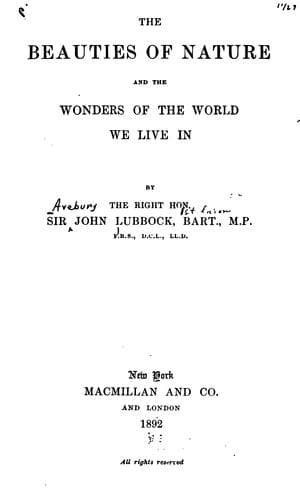
The Beauties of Nature, and the Wonders of the World We Live InLubbock, John, Sir
Philosophy
The Beauties of Nature, and the Wonders of the World We Live In
Lubbock, John, Sir
Astronomy; Natural history; Physical geography
As regards the origin of volcanoes there have been two main theories.
Impressed by the magnitude and grandeur of the phenomena, enhanced as
they are by their destructive character, many have been disposed to
regard the craters of volcanoes as gigantic chimneys, passing right
through the solid crust of the globe, and communicating with a central
fire. Recent researches, however, have indicated that, grand and
imposing as they are, volcanoes must yet be regarded as due mainly to
local and superficial causes.
A glance at the map shows that volcanoes are almost always situated on,
or near, the sea coast. From the interior of continents they are
entirely wanting. The number of active volcanoes in the Andes,
contrasted with their absence in the Alps and Ourals, the Himalayas, and
Central Asian chains, is very striking. Indeed, the Pacific Ocean is
encircled, as Ritter has pointed out, by a ring of fire. Beginning with
New Zealand, we have the Volcanoes of Tongariro, Whakaii, etc.; thence
the circle passes through the Fiji Islands, Solomon Islands, New Guinea,
Timor, Flores, Sumbava, Lombock, Java, Sumatra, the Philippines, Japan,
the Aleutian Islands, along the Rocky Mountains, Mexico, Peru, and
Chili, to Tierra del Fuego, and, in the far south, to the two great
Volcanoes of Erebus and Terror on Victoria Land.
We know that the contraction of the Earth's surface with the strains and
fractures, the compression and folds, which must inevitably result, is
still in operation, and must give rise to areas of high temperature,
and consequently to volcanoes. We must also remember that the real
mountain chains of our earth are the continents, compared to which even
the Alps and Andes are mere wrinkles. It is along the lines of the great
mountain chains, that is to say, along the main coast lines, rather than
in the centres of the continents, which may be regarded as comparatively
quiescent, that we should naturally expect to find the districts of
greatest heat, and this is perhaps why volcanoes are generally
distributed along the coast lines.
Another reason for regarding Volcanoes as local phenomena is that many
even of those comparatively near one another act quite independently.
This is so with Kilauea and Mouna Loa, both on the small island of
Hawaii.
Again, if volcanoes were in connection with a great central sea of fire,
the eruptions must follow the same laws as regulate the tides. This,
however, is not the case. There are indeed indications of the existence
of slight tides in the molten lake which underlies Vesuvius, and during
the eruption of 1865 there was increased activity twice a day, as we
should expect to find in any great fluid reservoir, but very different
indeed from what must have been the case if the mountain was in
connection with a central ocean of molten matter.
Public-domain text, read in full here on John Shaqi.
Reviews
Reviews
No reviews yet
Be the first to share your thoughts on this work.
Elsewhere in the archive
Join the Discussion
Join the discussion
Sign in to leave a comment or review.
Sign InorCreate an account