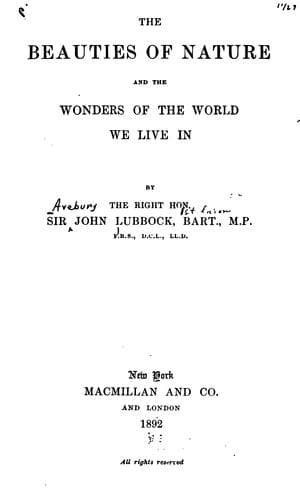
The Beauties of Nature, and the Wonders of the World We Live InLubbock, John, Sir
Philosophy
The Beauties of Nature, and the Wonders of the World We Live In
Lubbock, John, Sir
Astronomy; Natural history; Physical geography
Indeed, unless the "crust" of our earth was of great thickness we should
be subject to perpetual earthquakes. No doubt these are far more
frequent than is generally supposed; indeed, with our improved
instruments it can be shown that instead of occasional vibrations, with
long intermediate periods of rest, we have in reality short intervals of
rest with long periods of vibration, or rather perhaps that the crust of
the earth is in constant tremor, with more violent oscillation from time
to time.
It appears, moreover, that earthquakes are not generally deep-seated.
The point at which the shock is vertical can be ascertained, and it is
also possible in some cases to determine the angle at which it emerges
elsewhere. When this has been done it has always been found that the
seat of disturbance must have been within 30 geographical miles of the
surface.
Yet, though we cannot connect volcanic action with the central heat of
the earth, but must regard it as a minor and local manifestation of
force, volcanoes still remain among the grandest, most awful, and at the
same time most magnificent spectacles which the earth can afford.
FOOTNOTES:
[38] Ruskin.
[39] _The Glaciers of the Alps._
[40] Ossian.
[41] Bullar, _Azores_.
[42] Tennyson.
[43] See especially Heim's great work, _Unt. ue. d. Mechanismus der
Gebirgsbildung_.
[44] In the last 150 years more than 1000 are recorded.
[45] _Letters from High Latitudes._
[46] _Glaciers of the Alps._
[47] _Mountaineering in 1861._
CHAPTER VII
WATER
Of all inorganic substances, acting in their own proper nature,
and without assistance or combination, water is the most
wonderful. If we think of it as the source of all the
changefulness and beauty which we have seen in the clouds; then
as the instrument by which the earth we have contemplated was
modelled into symmetry, and its crags chiselled into grace;
then as, in the form of snow, it robes the mountains it has
made, with that transcendent light which we could not have
conceived if we had not seen; then as it exists in the foam of
the torrent, in the iris which spans it, in the morning mist
which rises from it, in the deep crystalline pools which mirror
its hanging shore, in the broad lake and glancing river,
finally, in that which is to all human minds the best emblem of
unwearied, unconquerable power, the wild, various, fantastic,
tameless unity of the sea; what shall we compare to this
mighty, this universal element, for glory and for beauty? or
how shall we follow its eternal cheerfulness of feeling? It is
like trying to paint a soul.--RUSKIN.
[Illustration: RYDAL WATER. _To face page 251._]
CHAPTER VII
WATER
In the legends of ancient times running water was proof against all
sorcery and witchcraft:
No spell could stay the living tide
Or charm the rushing stream.[48]
There was much truth as well as beauty in this idea.
Public-domain text, read in full here on John Shaqi.
Reviews
Reviews
No reviews yet
Be the first to share your thoughts on this work.
Elsewhere in the archive
Join the Discussion
Join the discussion
Sign in to leave a comment or review.
Sign InorCreate an account