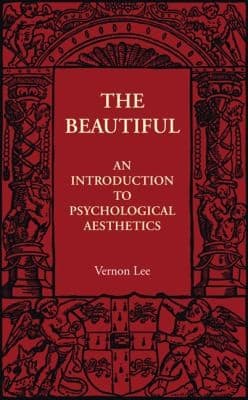
The Beautiful: An Introduction to Psychological AestheticsLee, Vernon
Philosophy
The Beautiful: An Introduction to Psychological Aesthetics
Lee, Vernon
Aesthetics; Form (Aesthetics); Psychology, Applied
On dismissing the practical and the scientific man because they were
_thinking away from aspects to things,_ I attempted to inventory the
_aspect_ in whose contemplation their aesthetic companion had
remained absorbed. There were the colours, that delicious
recently-washed blue, that lilac and russet, which gave the man his
immediate shock of passive and (as much as smell and taste) bodily
pleasure. But besides these my inventory contained another kind of
item: what I described as a fan-like arrangement of sharply
convergent lines and an exquisitely phrased sky-line of hills, picked
up at rhythmical intervals into sharp crests and dropping down
merely to rush up again in long rapid concave curves. And besides
all this, there was the outline of a distant mountain, rising flamelike
against the sky. It was all these items made up of _lines_ (skyline,
outline, and lines of perspective!) which remained unchanged when
the colours were utterly changed by looking through stained glass,
and unchanged also when the colouring was reduced to the barest
monochrome of a photograph or a pencil drawing; nay remained the
same despite all changes of scale in that almost colourless
presentment of them. Those items of the aspect were, as we all know,
_Shapes._ And with altered colours, and colours diminished to just
enough for each line to detach itself from its ground, those Shapes
could be contemplated and called beautiful.
CHAPTER V
PERCEPTION OF RELATIONS
WHY should this be the case? Briefly, because colours (and sounds)
as such are forced upon us by external stimulation of our organs of
sight and hearing, neither more nor less than various temperatures,
textures, tastes and smells are forced upon us from without through
the nervous and cerebral mechanism connected with our skin,
muscle, palate and nose. Whereas shapes instead of being thus nilly
willy _seen_ or _heard,_ are, at least until we know them, _looked_
at or _listened_ to, that is to say _taken in_ or _grasped,_ by mental
and bodily activities which meet, but may also refuse to meet, those
sense stimulations. Moreover, because these mental and bodily
activities, being our own, can be rehearsed in what we call our
memory without the repetition of the sensory stimulations which
originally started them, and even in the presence of different ones.
Public-domain text, read in full here on John Shaqi.
Reviews
Reviews
No reviews yet
Be the first to share your thoughts on this work.
Join the Discussion
Join the discussion
Sign in to leave a comment or review.
Sign InorCreate an account