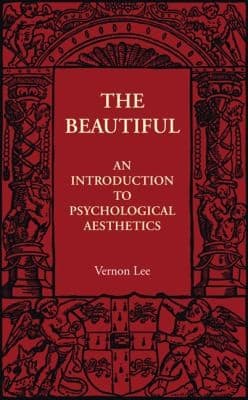
The Beautiful: An Introduction to Psychological Aesthetics — John Shaqi
The Beautiful: An Introduction to Psychological AestheticsLee, Vernon
Philosophy
The Beautiful: An Introduction to Psychological Aesthetics
Lee, Vernon
Aesthetics; Form (Aesthetics); Psychology, Applied
I HAVE tried in this little volume to explain aesthetic preference,
particularly as regards visible shapes, by the facts of mental science.
But my explanation is addressed to readers in whom I have no right
to expect a previous knowledge of psychology, particularly in its
more modern developments. I have therefore based my explanation
of the problems of aesthetics as much as possible upon mental facts
familiar, or at all events easily intelligible, to the lay reader. Now
mental facts thus available are by no means the elementary
processes with which analytical and, especially experimental,
psychology has dealings. They are, on the contrary, the everyday,
superficial and often extremely confused views which practical life
and its wholly unscientific vocabulary present of those ascertained
or hypothetical scientific facts. I have indeed endeavoured (for
instance in the analysis of perception as distinguished from
sensation) to impart some rudiments of psychology in the course of
my aesthetical explanation, and I have avoided, as much as possible,
misleading the reader about such fearful complexes and cruxes as
_memory, association_ and _imagination._ But I have been obliged
to speak in terms intelligible to the lay reader, and I am fully aware
that these terms correspond only very approximately to what is, or at
present passes as, psychological fact. I would therefore beg the
psychologist (to whom I offer this little volume as a possible slight
addition even to his stock of facts and hypotheses) to understand that
in speaking, for instance, of Empathy as involving a _thought_ of
certain activities, I mean merely that whatever happens has the same
result _as if we thought_; and that the processes, whatever they may
be (also in the case of measuring, comparing and co-ordinating),
translate themselves, _when they are detected,_ into _thoughts;_ but
that I do not in the least pre-judge the question whether the
processes, the "thoughts," the measuring, comparing etc. exist on
subordinate planes of consciousness or whether they are mainly
physiological and only occasionally abutting in conscious resultants.
Similarly, lack of space and the need for clearness have obliged me
to write as if shape-preference invariably necessitated the detailed
process of ocular perception, instead of being due, as is doubtless
most often the case, to every kind of associative abbreviation and
equivalence of processes.
VERNON LEE
Maiano _near_ Florence,_
Easter_ 1913.
CHAPTER I
THE ADJECTIVE "BEAUTIFUL"
Public-domain text, read in full here on John Shaqi.
Reviews
Reviews
No reviews yet
Be the first to share your thoughts on this work.
Join the Discussion
Join the discussion
Sign in to leave a comment or review.
Sign InorCreate an account