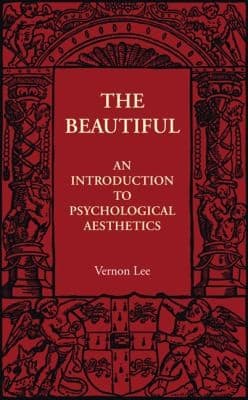
The Beautiful: An Introduction to Psychological AestheticsLee, Vernon
Philosophy
The Beautiful: An Introduction to Psychological Aesthetics
Lee, Vernon
Aesthetics; Form (Aesthetics); Psychology, Applied
Such as I have defined and exemplified it in our Rising Mountain,
Empathy is, together with mere Sensation, probably the chief factor
of preference, that is of an alternative of satisfaction and
dissatisfaction, in aesthetic contemplation, the muscular adjustments
and the measuring, comparing and coordinating activities by which
Empathy is started, being indeed occasionally difficult and
distressing, but giving in themselves little more than a negative
satisfaction, at the most that of difficulty overcome and suspense
relieved. But although nowhere so fostered as in the contemplation
of shapes, Empathy exists or tends to exist throughout our mental
life. It is, indeed, one of our simpler, though far from absolutely
elementary, psychological processes, entering into what is called
imagination, sympathy, and also into that inference from our own
inner experience which has shaped all our conceptions of an outer
world, and given to the intermittent and heterogeneous sensations
received from without the framework of our constant and highly
unified inner experience, that is to say, of our own activities and
aims. Empathy can be traced in all of modes of speech and thought,
particularly in the universal attribution of _doing_ and _having_ and
_tending_ where all we can really assert is successive and varied
_being._ Science has indeed explained away the anthropomorphic
implications of _Force_ and _Energy, Attraction_ and _Repulsion_;
and philosophy has reduced _Cause_ and _Effect_ from implying
intention and effort to meaning mere constant succession. But
Empathy still helps us to many valuable analogies; and it is possible
that without its constantly checked but constantly renewed action,
human thought would be without logical cogency, as it certainly
would be without poetical charm. Indeed if Empathy is so recent a
discovery, this may be due to its being part and parcel of our
thinking; so that we are surprised to learn its existence, as Molière's
good man was to hear that be talked prose.
CHAPTER X
THE MOVEMENT OF LINES
Public-domain text, read in full here on John Shaqi.
Reviews
Reviews
No reviews yet
Be the first to share your thoughts on this work.
Join the Discussion
Join the discussion
Sign in to leave a comment or review.
Sign InorCreate an account