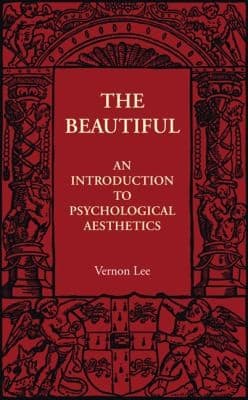
The Beautiful: An Introduction to Psychological AestheticsLee, Vernon
Philosophy
The Beautiful: An Introduction to Psychological Aesthetics
Lee, Vernon
Aesthetics; Form (Aesthetics); Psychology, Applied
But now let us put ourselves in the place of their aesthetically
contemplative fellow-traveller. And, for simplicity's sake, let us
imagine him contemplating more especially one shape in that
landscape, the shape of that distant mountain, the one whose
"rising"--came to an end as soon as we set to climbing it. The
mountain is so far off that its detail is entirely lost; all we can see is
a narrow and pointed cone, perhaps a little _toppling_ to one side, of
uniform hyacinth blue _detaching_ itself from the clear evening sky,
into which, from the paler misty blue of the plain, it _rises,_ a mere
bodiless shape. It _rises._ There is at present no doubt about its
_rising._ It rises and keeps on rising, never stopping unless _we_
stop looking at it. It rises and never _has_ risen. Its drama of two
lines _striving_ (one with more suddenness of energy and purpose
than the other) to _arrive_ at a particular imaginary point in the sky,
_arresting_ each other's _progress_ as they _meet_ in their
_endeavour,_ this simplest empathic action of an irregular and by no
means rectilinear triangle, goes on repeating itself, like the parabola
of a steadily spirting fountain: for ever accomplishing itself anew
and for ever accompanied by the same effect on the feelings of the
beholder.
It is this reiterative nature which, joined to its schematic definiteness,
gives Empathy its extraordinary power over us. Empathy, as I have
tried to make clear to the Reader, is due not only to the movements
which we are actually making in the course of shape-perception, to
present movements with their various modes of speed, intensity and
facility and their accompanying intentions; it is due at least as much
to our accumulated and averaged past experience of movements of
the same kind, also with _their_ cognate various modes of speed,
intensity, facility, and _their_ accompanying intentions. And being
thus residual averaged, and essential, this empathic movement, this
movement attributed to the lines of a shape, is not clogged and
inhibited by whatever clogs and inhibits each separate concrete
experience of the kind; still less is it overshadowed in our awareness
by the _result_ which we foresee as goal of our real active
proceedings. For unless they involve bodily or mental strain, our
real and therefore transient movements do not affect us as pleasant
or unpleasant, because our attention is always outrunning them to
some momentary goal; and the faint awareness of them is usually
mixed up with other items, sensations and perceptions, of wholly
different characters. Thus, in themselves and apart from their aims,
our bodily movements are never interesting except inasmuch as
requiring new and difficult adjustments, or again as producing
perceptible repercussions in our circulatory, breathing and balancing
apparatus: a waltz, or a dive or a gallop may indeed be highly
exciting, thanks to its resultant organic perturbations and its
Public-domain text, read in full here on John Shaqi.
Reviews
Reviews
No reviews yet
Be the first to share your thoughts on this work.
Join the Discussion
Join the discussion
Sign in to leave a comment or review.
Sign InorCreate an account