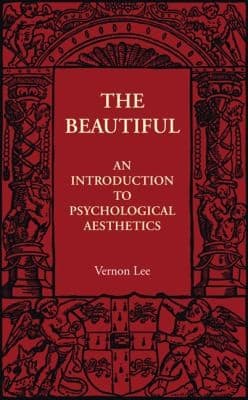
The Beautiful: An Introduction to Psychological AestheticsLee, Vernon
Philosophy
The Beautiful: An Introduction to Psychological Aesthetics
Lee, Vernon
Aesthetics; Form (Aesthetics); Psychology, Applied
associative repercussion into the seat of what our fathers correctly
called "animal spirits," would be impossible unless reiteration, the
reiteration of repeated acts of attention, had allowed the various
empathic significance, the various _dynamic values,_ of given
shapes to sink so deeply into us, to become so habitual, that even a
rapid glance (as when we perceive the upspringing lines of a
mountain from the window of an express train) may suffice to evoke
their familiar dynamic associations. Thus contemplation explains, so
to speak, why contemplation may be so brief as to seem no
contemplation at all: past repetition has made present repetition
unnecessary, and the empathic, the dynamic scheme of any
particular shape may go on working long after the eye is fixed on
something else, or be started by what is scarcely a perception at all;
we feel joy at the mere foot-fall of some beloved person, but we do
so because he is already beloved. Thus does the reiterative character
essential to Empathy explain how our contemplative satisfaction in
shapes, our pleasure in the variously combined _movements of
lines,_ irradiates even the most practical, the apparently least
contemplative, moments and occupations of our existence.
But this is not all. This reiterative character of Empathy, this fact
that the mountain is always rising without ever beginning to sink or
adding a single cubit to its stature, joined to the abstract (the
_infinitive of the verb)_ nature of the suggested activity, together
account for art's high impersonality and its existing, in a manner,
_sub specie aeternitatis._ The drama of lines and curves presented
by the humblest design on bowl or mat partakes indeed of the
strange immortality of the youths and maidens on the _Grecian
Urn,_ to whom Keats, as you remember, says:--
"Fond lover, never, never canst thou kiss,
Though winning near the goal. Yet, do not grieve;
She cannot fade; though thou hast not thy bliss,
For ever wilt thou love, and she be fair."
And thus, in considering the process of Aesthetic Empathy, we find
ourselves suddenly back at our original formula: Beautiful means
satisfactory in contemplation, and contemplation not of Things but
of Shapes which are only Aspects of them.
CHAPTER XI
THE CHARACTER OF SHAPES
Public-domain text, read in full here on John Shaqi.
Reviews
Reviews
No reviews yet
Be the first to share your thoughts on this work.
Join the Discussion
Join the discussion
Sign in to leave a comment or review.
Sign InorCreate an account