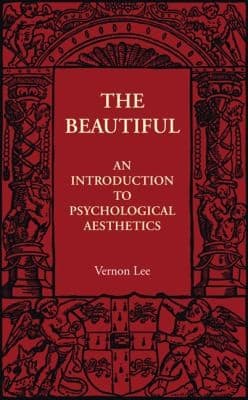
The Beautiful: An Introduction to Psychological AestheticsLee, Vernon
Philosophy
The Beautiful: An Introduction to Psychological Aesthetics
Lee, Vernon
Aesthetics; Form (Aesthetics); Psychology, Applied
Upon our knowledge of the precise stage of such pictorial
development depends our correct recognition of what things, and
particularly what spatial relations and locomotion, of things, the
painter is intended to represent. Thus when a Byzantine
draughtsman puts his figures in what look to us as superposed tiers,
he is merely trying to convey their existence behind one another on
a common level. And what we take for the elaborate contortions of
athletes and Athenas on Sixth Century vases turns out to be nothing
but an archaic representation of ordinary walking and running.
The suggestion of locomotion depends furthermore on anatomy.
What the figures of a painting are intended to be doing, what they
are intended to have just done and to be going to do, in fact all
questions about their action and business, are answered by reference
to their bodily structure and its real or supposed possibilities. The
same applies to expression of mood.
The impassiveness of archaic Apollos is more likely to be due to
anatomical difficulties in displacing arms and legs, than to lack of
emotion on the part of artists who were, after all, contemporaries
either of Sappho or Pindar. And it is more probable that the
sculptors of Aegina were still embarrassed about the modelling of
lips and cheeks than that, having Homer by heart, they imagined his
heroes to die silently and with a smirk.
I have entered into this question of perspective and anatomy, and
given the above examples, because they will bring home to the
reader one of the chief principles deduced from our previous
examination into the psychology of our subject, namely that _all
thinking about things is thinking away from the Shapes suggesting
those things, since it involves knowledge which the Shapes in
themselves do not afford._ And I have insisted particularly upon the
dependence of representations of locomotion upon knowledge of
three-dimensional existence, because, before proceeding to the
relations of Subject and Form in painting, I want to impress once
more upon the reader the distinction between the _locomotion of
things_ (locomotion active or passive) and what, in my example of
the _mountain which rises,_ I have called the _empathic movement
of lines._ Such _movement of lines_ we have seen to be a scheme of
activity suggested by our own activity in taking stock of a
two-dimensional-shape; an _idea,_ or _feeling_ of activity which we,
being normally unaware of its origin in ourselves, project into the
shape which has suggested it, precisely as we project our sensation
of _red_ from our own eye and mind into the object which has
deflected the rays of light in such a way as to give us that _red_
sensation. Such _empathic,_ attributed, movements of lines are
therefore intrinsic qualities of the shapes whose active perception
has called them forth in our imagination and feeling; and being
qualities of the shapes, they inevitably change with every alteration
Public-domain text, read in full here on John Shaqi.
Reviews
Reviews
No reviews yet
Be the first to share your thoughts on this work.
Elsewhere in the archive
Join the Discussion
Join the discussion
Sign in to leave a comment or review.
Sign InorCreate an account