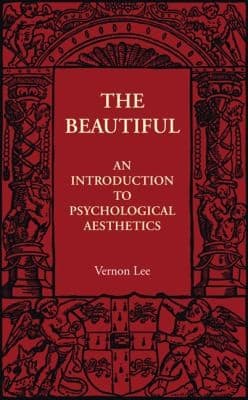
The Beautiful: An Introduction to Psychological AestheticsLee, Vernon
Philosophy
The Beautiful: An Introduction to Psychological Aesthetics
Lee, Vernon
Aesthetics; Form (Aesthetics); Psychology, Applied
Be that as it may, the intermittent but recurrent character of shape
contemplation, the fact that it is inconceivably brief and amazingly
repetitive, that it has the essential quality of identity because of
reiteration, all this explains also two chief points of our subject. First:
how an aesthetic impression, intentionally or accidentally conveyed
in the course of wholly different interests, can become a constant
accompaniment to the shifting preoccupations of existence, like the
remembered songs which sing themselves silently in our mind and
the remembered landscapes becoming an intangible background to
our ever-varying thoughts. And, secondly, it explains how art can
fulfil the behests of our changing and discursive interest in things
while satisfying the imperious unchanging demands of the
contemplated preference for beautiful aspects. And thus we return to
my starting-point in dealing with art: that art is conditioned by the
desire for beauty while pursuing entirely different aims, and
executing any one of a variety of wholly independent non-aesthetic
tasks.
CHAPTER XVI
INFORMATION ABOUT THINGS
AMONG the facts which Painting is set to tell us about things, the
most important, after cubic existence, is Locomotion. Indeed in the
development of the race as well as in that of the individual, pictorial
attention to locomotion seems to precede attention to cubic existence.
For when the palaeolithic, or the Egyptian draughtsman, or even the
Sixth Century Greek, unites profile legs and head with a full-face
chest; and when the modern child supplements the insufficiently
projecting full-face nose by a profile nose tacked on where we
expect the ear, we are apt to think that these mistakes are due to
indifference to the cubic nature of things. The reverse is, however,
the case. The primitive draughtsman and the child are recording
impressions received in the course of the locomotion either of the
thing looked at or of the spectator. When they unite whatever
consecutive aspects are most significant and at the same time easiest
to copy, they are in the clutches of their cubic experience, and what
they are indifferent about, perhaps unconscious of, is the
_two-dimensional_ appearance which a body presents when its parts are
seen simultaneously and therefore from a single point of view. The
progress of painting is always from representing the Consecutive to
representing the Simultaneous; perspective, foreshortening, and later,
light and shade, being the scientific and technical means towards
this end.
Public-domain text, read in full here on John Shaqi.
Reviews
Reviews
No reviews yet
Be the first to share your thoughts on this work.
Elsewhere in the archive
Join the Discussion
Join the discussion
Sign in to leave a comment or review.
Sign InorCreate an account