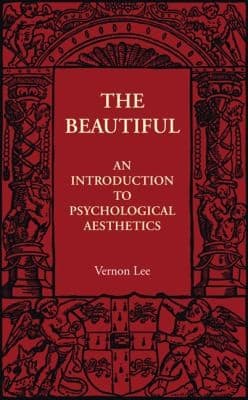
The Beautiful: An Introduction to Psychological AestheticsLee, Vernon
Philosophy
The Beautiful: An Introduction to Psychological Aesthetics
Lee, Vernon
Aesthetics; Form (Aesthetics); Psychology, Applied
knocked out and with a scarce intelligible incident of obsolete
mythology portrayed upon it, has claims upon our feelings which the
most useful modern mechanism ceases to have even in the intervals
of its use, and which the newspaper, crammed full of the most
important tidings, loses as soon as we have taken in its contents.
CHAPTER XVII
THE CO-OPERATION OF THINGS AND SHAPES
DURING the Middle Ages and up to recent times the chief task of
painting has been, ostensibly, the telling and re-telling of the same
Scripture stories; and, incidentally, the telling them with the addition
of constantly new items of information about _things:_ their volume,
position, structure, locomotion, light and shade and interactions of
texture and atmosphere; to which items must be added others of
psychological or (pseudo)-historical kind, how it all came about, in
what surroundings and dresses, and accompanied by what feelings.
This task, official and unofficial, is in no way different from those
fulfilled by the man of science and the practical man, both of whom
are perpetually dealing with additional items of information. But
mark the difference in the artist's way of accomplishing this task: a
scientific fact is embodied in the progressive mass of knowledge,
assimilated, corrected; a practical fact is taken in consideration, built
upon; but the treatise, the newspaper or letter, once it has conveyed
these facts, is forgotten or discarded. The work of art on the contrary
is remembered and cherished; or at all events it is made with the
intention of being remembered and cherished. In other words and as
I shall never tire of repeating, the differentiating characteristic of art
is that it makes _you think back to the shape_ once that shape has
conveyed its message or done its business of calling your attention
or exciting your emotions. And the first and foremost problem, for
instance of painting, is that of preventing the beholder's eye from
being carried, by lines of perspective, outside the frame and even
persistently out of the centre of the picture; the sculptor (and this is
the real reason of the sculptor Hildebrand's rules for plastic
composition) obeying a similar necessity of keeping the beholder's
eye upon the main masses of his statue, instead of diverting it, by
projections at different distances, like the sticking out arms and
hands of Roman figures. So much for the eye of the body: the
beholder's curiosity must similarly not be carried outside the work of
art by, for instance, an incomplete figure (legs without a body!) or
an unfinished gesture, this being, it seems to roe, the only real
reason against the representation of extremely rapid action and
transitory positions. But when the task of conveying information
implies that the beholder's thoughts be deliberately led from what is
represented to what is not, then this centrifugal action is dealt with
so as to produce a centripetal one back to the work of art: the painter
Public-domain text, read in full here on John Shaqi.
Reviews
Reviews
No reviews yet
Be the first to share your thoughts on this work.
Elsewhere in the archive
Join the Discussion
Join the discussion
Sign in to leave a comment or review.
Sign InorCreate an account