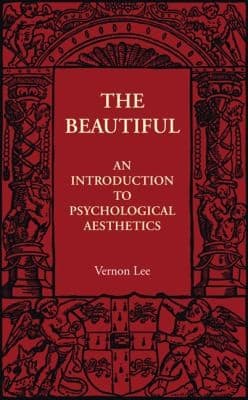
The Beautiful: An Introduction to Psychological AestheticsLee, Vernon
Philosophy
The Beautiful: An Introduction to Psychological Aesthetics
Lee, Vernon
Aesthetics; Form (Aesthetics); Psychology, Applied
suggests questions of _how_ and _why_ which get their answers in
some item obliging you to take fresh stock of the picture. What Is
the meaning of the angels and evidently supernatural horseman in
the foreground of Raphael's _Heliodorus?_ Your mind flies to the
praying High Priest in the central recess of the temple, and in going
backwards and forwards between him, the main group and the
scattered astonished bystanders, you are effectually enclosed within
the arches of that marvellous composition, and induced to explore
every detail of its lovely and noble constituent shapes.
The methods employed thus to keep the beholder's attention inside
the work of art while suggesting things beyond it, naturally vary
with the exact nature of the non-aesthetic task which has been set to
the artist; and with the artist's individual endowment and even more
with the traditional artistic formulae of his country and time:
Raphael's devices in _Heliodorus_ could not have been compassed
by Giotto; and, on the other hand, would have been rejected as
"academic" by Manet. But whatever the methods employed, and
however obviously they reveal that satisfactory form-contemplation
is the one and invariable _condition_ as distinguished from the
innumerable varying _aims,_ of all works of art, the Reader will find
them discussed not as methods for securing attention to the shape,
but as methods of employing that shape for some non-aesthetic
purpose; whether that purpose be inducing you to drink out of a cup
by making its shape convenient or suggestive; or inducing you to
buy a particular commodity by branding its name and virtues on
your mind; or fixing your thoughts on the Madonna's sorrows; or
awaking your sympathy for Isolde's love tragedy. And yet it is
evident that the artist who shaped the cup or designed the poster
would be horribly disappointed if you thought only of drinking or of
shopping and never gave another look to the cup or the poster; and
that Perugino or Wagner would have died of despair if his
suggestion of the Madonna's sorrows or of Isolde's love-agonies had
been so efficacious as to prevent anybody from looking twice at the
fresco or listening to the end of the opera. This inversion of the
question is worth inquiring into, because, like the analogous paradox
about the pictorial "realisation" of cubic existence, it affords an
illustration of some of the psychological intricacies of the relation
between Art and the Beautiful. This is how I propose to explain it.
Public-domain text, read in full here on John Shaqi.
Reviews
Reviews
No reviews yet
Be the first to share your thoughts on this work.
Elsewhere in the archive
Join the Discussion
Join the discussion
Sign in to leave a comment or review.
Sign InorCreate an account