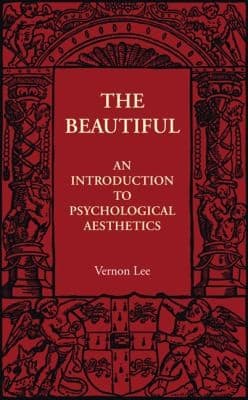
The Beautiful: An Introduction to Psychological AestheticsLee, Vernon
Philosophy
The Beautiful: An Introduction to Psychological Aesthetics
Lee, Vernon
Aesthetics; Form (Aesthetics); Psychology, Applied
point of comparison. "This _dates_ such or such a style"--"_Plein
Air_ already attempted by a Giottesque! Degas forestalled by a Cave
Dweller!" etc. etc. And finally days when the Diarist is haunted by
the thought of what the represented person will do next: "Would
Michelangelo's Jeremiah knock his head if he got up?"--"How will
the Discobolus recover when he has let go the quoit?"--or haunted
by thoughts even more frivolous (though not any less aesthetically
irrelevant!) like "How wonderfully like Mrs So and So!" "The living
image of Major Blank!"--"How I detest auburn people with
sealing-wax lips!" _ad lib._
Such different _thinkings away from the shapes_ are often traceable
to previous orientation of the thoughts or to special states of body
and feelings. But explicable or not in the particular case, these
varieties of one's own aesthetic responsiveness will persuade the
Reader who has verified their existence, that contemplative
satisfaction in shapes and its specific emotion cannot be given by the
greatest artist or the finest tradition, unless the beholder meets their
efforts more than half way.
The spontaneous collaboration of the beholder is especially
indispensable for Aesthetic Empathy. As we have seen, empathic
modes of movement and energy and intention are attributed to
shapes and to shape elements, in consequence of the modes of
movement and energy involved in mere shape perception; but shape
perception does not necessarily call forth empathic imagination. And
the larger or smaller dynamic dramas of effort, resistance,
reconciliation, cooperation which constitute the most poignant
interest of a pictorial or plastic composition, are inhibited by bodily
or mental states of a contrary character. We cease to _feel_
(although we may continue, like Coleridge, to _see_) that the lines
of a mountain or a statue _are rising,_ if we ourselves happen to feel
as if our feet were of lead and our joints turning to water. The
coordinated interplay of empathic movement which makes certain
mediaeval floor patterns, and also Leonardo's compositions, into
whirling harmonies as of a planetary system, cannot take place in
our imagination on days of restlessness and lack of concentration.
Nay it may happen that arrangements of lines which would flutter
and flurry us on days of quiet appreciativeness, will become in every
sense "sympathetic" on days when we ourselves feel fluttered and
flurried. But lack of responsiveness may be due to other causes. As
there are combinations of lines which take longer to perceive
because their elements or their coordinating principles are
unfamiliar, so, and even more so, are there empathic schemes (or
dramas) which baffle dynamic imagination when accustomed to
something else and when it therefore meets the new demand with an
unsuitable empathic response. Empathy is, even more than mere
perception, a question of our activities and therefore of our habits;
and the aesthetic sensitiveness of a time and country (say the
Public-domain text, read in full here on John Shaqi.
Reviews
Reviews
No reviews yet
Be the first to share your thoughts on this work.
Elsewhere in the archive
Join the Discussion
Join the discussion
Sign in to leave a comment or review.
Sign InorCreate an account