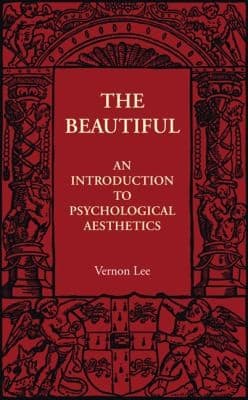
The Beautiful: An Introduction to Psychological AestheticsLee, Vernon
Philosophy
The Beautiful: An Introduction to Psychological Aesthetics
Lee, Vernon
Aesthetics; Form (Aesthetics); Psychology, Applied
Putting aside these kind of cases, the transfer (usually accomplished
by a word) of the aesthetic emotion, or at least of a willingness for
aesthetic emotion, is probably one of the explanations of the spread
of aesthetic interest from one art to another, as it is the explanation
of some phases of aesthetic development in the individual. The
present writer can vouch for the case of at least one real child in
whom the possibility of aesthetic emotion, and subsequently of
aesthetic appreciation, was extended from music and natural scenery
to pictures and statues, by the application of the word _Beautiful_ to
each of these different categories. And something analogous
probably helped on the primaeval recognition that the empathic
pleasures hitherto attached to geometrical shapes might be got from
realistic shapes, say of bisons and reindeer, which had hitherto been
admired for their lifelikeness and skill, but not yet subjected to any
aesthetic discrimination (_cf_. p. 96). Similarly, in our own times,
the delight in natural scenery is being furthered by the development
of landscape painting, rather than furthering it. Nay I venture to
suggest that it was the habit of the aesthetic emotion such as
mediaeval men received from the proportions, directions, and
coordination of lines in their cathedrals of stone or brick which set
their musicians to build up, like Browning's _Abt Vogler,_ the soul's
first balanced and coordinated dwellings made of sounds.
Be this last as it may, it is desirable that the Reader should accept,
and possibly verify for himself, the psychological fact of the
_storage and transfer of aesthetic emotion._ Besides, the points
already mentioned, it helps to explain several of the cruxes and
paradoxes of aesthetics. First and foremost that dictum _De
Gustibus non est disputandum_ which some philosophers and even
aestheticians develop into an explicit denial of all intrinsic
shape-preferences, and an assertion that _beautiful_ and _ugly_ are merely
other names for _fashionable_ and _unfashionable, original_ and
_unoriginal,_ or _suitable_ and _unsuitable._ As I have already
pointed out, differences of taste are started by the perceptive and
empathic habits, schematically various, of given times and places,
and also by those, especially the empathic habits, connected with
individual nervous condition: people accustomed to the round arch
finding the Gothic one unstable and eccentric; and, on the other
hand, a person taking keen pleasure in the sudden and lurching lines
of Lotto finding those of Titian tame and humdrum. But such
intrinsically existing preferences and incompatibility are quite
enormously increased by an emotional bias for or against a
particular kind of art; by which I mean a bias not due to that art's
peculiarities, but preventing our coming in real contact with them.
Public-domain text, read in full here on John Shaqi.
Reviews
Reviews
No reviews yet
Be the first to share your thoughts on this work.
Elsewhere in the archive
Join the Discussion
Join the discussion
Sign in to leave a comment or review.
Sign InorCreate an account