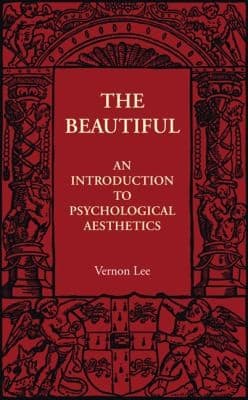
The Beautiful: An Introduction to Psychological AestheticsLee, Vernon
Philosophy
The Beautiful: An Introduction to Psychological Aesthetics
Lee, Vernon
Aesthetics; Form (Aesthetics); Psychology, Applied
IN dealing with familiarity as a multiplying factor of aesthetic
appreciation, I have laid stress on its effect in facilitating the
perception and the empathic interpretation of shapes. But repetition
directly affects the emotion which may result from these processes;
and when any emotion has become habitual, it tends to be stored in
what we call memory, and to be called forth not merely by the
processes in which it originated, but also independently of the whole
of them, or in answer to some common or equivalent factor. We are
so accustomed to this psychological fact that we do not usually seem
to recognise its existence. It is the explanation of the power of words,
which, apart from any images they awaken, are often irresistibly
evocative of emotion. And among other emotions words can evoke
the one due to the easy perception and to the life-corroborating
empathic interpretation of shapes. The word _Beautiful,_ and its
various quasi synonyms, are among the most emotionally suggestive
in our vocabulary, carrying perhaps a vague but potent remembrance
of our own bodily reaction to the emotion of admiration; nay even
eliciting an incipient rehearsal of the half-parted lips and slightly
thrown-back head, the drawn-in breath and wide-opened eyes, with
which we are wont to meet opportunities of aesthetic satisfaction. Be
this last as it may, it is certain that the emotion connected with the
word _Beautiful_ can be evoked by that word alone, and without an
accompanying act of visual or auditive perception. Indeed beautiful
shapes would lose much of their importance in our life, if they did
not leave behind them such emotional traces, capable of revival
under emotionally appropriate, though outwardly very dissimilar,
circumstances; and thereby enormously increasing some of our
safest, perhaps because our most purely subjective, happiness.
Instead therefore of despising the raptures which the presence of a
Venus of Milo or a Sixtine Madonna can inspire in people
manifestly incapable of appreciating a masterpiece, and sometimes
barely glancing at it, we critical persons ought to recognise in this
funny, but consoling, phenomenon an additional proof of the power
of Beauty, whose specific emotion can thus be evoked by a mere
name and so transferred from some past experience of aesthetic
admiration to a. present occasion which would otherwise be mere
void and disappointment.
Public-domain text, read in full here on John Shaqi.
Reviews
Reviews
No reviews yet
Be the first to share your thoughts on this work.
Elsewhere in the archive
Join the Discussion
Join the discussion
Sign in to leave a comment or review.
Sign InorCreate an account