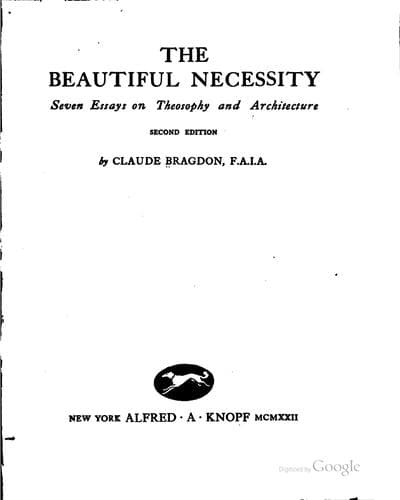
The Beautiful Necessity: Seven Essays on Theosophy and ArchitectureBragdon, Claude Fayette
Philosophy
The Beautiful Necessity: Seven Essays on Theosophy and Architecture
Bragdon, Claude Fayette
Architecture; Theosophy
The characteristic differences between music and architecture are the
same as those which subsist between time and space. Now time and space
are such abstract ideas that they can be dealt with best through
their corresponding correlatives in the natural world, for it is a
fundamental theosophic tenet that nature everywhere abounds in such
correspondences; that nature, in its myriad forms, is indeed the
concrete presentment of abstract unities. The energy which everywhere
animates form is a type of time within space; the mind working in
and through the body is another expression of the same thing.
Correspondingly, music is dynamic, subjective, mental, of one
dimension; while architecture is static, objective, physical, of three
dimensions; sustaining the same relation to music and the other
arts as does the human body to the various organs which compose, and
consciousnesses which animate it (it being the reservatory of these
organs and the vehicle of these consciousnesses); and a work of
architecture in like manner may and sometimes does include all of the
other arts within itself. Sculpture accentuates and enriches, painting
adorns, works of literature are stored within it, poetry and the drama
awake its echoes, while music thrills to its uttermost recesses, like
the very spirit of life tingling through the body's fibres.
Such being the relation between them, the difference in the nature of
the ideas bodied forth in music and in architecture becomes apparent.
Music is interior, abstract, subjective, speaking directly to the soul
in a simple and universal language whose meaning is made personal and
particular in the breast of each listener: "Music alone of all the
arts," says Balzac, "has power to make us live within ourselves."
A work of architecture is the exact opposite of this: existing
principally and primarily for the uses of the body, it is like the
body a concrete organism, attaining to esthetic expression only in
the reconciliation and fulfilment of many conflicting practical
requirements. Music is pure beauty, the voice of the unfettered
and perpetually vanishing soul of things; architecture is that soul
imprisoned in a form, become subject to the law of causality, beaten
upon by the elements, at war with gravity, the slave of man. One is
the Ariel of the arts; the other, Caliban.
Public-domain text, read in full here on John Shaqi.
Reviews
Reviews
No reviews yet
Be the first to share your thoughts on this work.
Join the Discussion
Join the discussion
Sign in to leave a comment or review.
Sign InorCreate an account