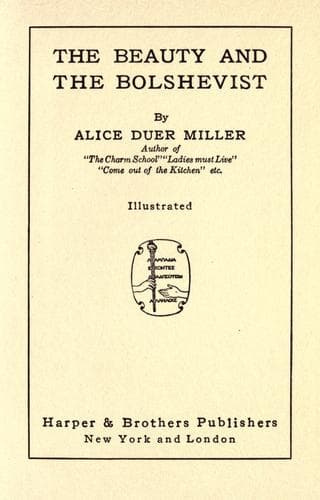
Children of the rich -- Fiction; Love stories; Newport (R.I.) -- Fiction; Socialists -- Fiction
“Dear Crystal,” he began, with that irritating reasonableness of manner
which implies that the speaker is going to be reasonable for two, “I’ve
been thinking over the situation. I know that you don’t love me, but
then I don’t believe you will ever be deeply in love with any one. I
don’t think you are that kind of woman.”
“Oh, Eddie, how dreadful!”
“I don’t see that at all. Just as well, perhaps. You don’t want to get
yourself into such a position as poor Eugenia.”
“I do, I would. I’d give anything to be as much in love as Eugenia.”
“What? With a fellow like that! A complete outsider.”
“Outside of what? The human race?”
“Well, no,” said Eddie, as if he were yielding a good deal, “but
outside of your traditions and your set.”
“My set! Good for him to be outside of it, I say. What have they ever
done to make anyone want to be inside of it? Why, David is an educated
gentleman. To hear him quote Horace—”
“Horace who?”
“Really, Eddie.”
“Oh, I see. You mean the poet. That’s nothing to laugh at, Crystal. It
was a natural mistake. I thought, of course, you meant some of those
anarchists who want to upset the world.”
Crystal looked at him more honestly and seriously than she had yet
done.
“Well, don’t you think there _is_ something wrong with the present
arrangement of things, Eddie?”
“No, I don’t, and I hate to hear you talk like a socialist.”
“I am a socialist.”
“You’re nothing of the kind.”
“I suppose I know what I am.”
“Not at all—not at all.”
“I certainly think the rich are too rich, while the poor are so
horridly poor.”
“_You’d_ get on well without your maid and your car and your father’s
charge accounts at all the shops, wouldn’t you?”
Though agreeable to talk seriously if you agree, it is correspondingly
dangerous if you disagree. Crystal stood up, trembling with an emotion
which Eddie, although he was rather angry himself, considered utterly
unaccountable.
“Yes,” she said, almost proudly, “I _am_ luxurious, I _am_ dependent on
those things. But whose fault is that? It’s the way I was brought
up—it’s all wrong. But, even though I am dependent on them, I believe I
could exist without them. I’d feel like killing myself if I didn’t
think so. Sometimes I want to go away and find out if I couldn’t live
and be myself without all this background of luxury. But at the
worst—I’m just one girl—suppose I were weak and couldn’t get on without
them? That wouldn’t prove that they are right. I’m not so blinded that
I can’t see that a system by which I profit may still be absolutely
wrong. But you always seem to think, Eddie, that it’s part of the
Constitution of the United States that you should have everything
you’ve always had.”
Eddie rose, too, with the manner of a man who has allowed things to go
far enough. “Look here, my dear girl,” he said, “I am a man and I’m
older than you, and have seen more of the world. I know you don’t mean
any harm, but I must tell you that this is very wicked, dangerous
talk.”
Public-domain text, read in full here on John Shaqi.
Reviews
Reviews
No reviews yet
Be the first to share your thoughts on this work.
Join the Discussion
Join the discussion
Sign in to leave a comment or review.
Sign InorCreate an account