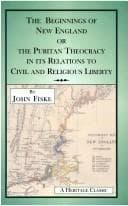
The Beginnings of New England: Or the Puritan Theocracy in its Relations to Civil and Religious LibertyFiske, John
History
The Beginnings of New England: Or the Puritan Theocracy in its Relations to Civil and Religious Liberty
Fiske, John
New England -- History -- Colonial period, ca. 1600-1775; Puritans
Had it not been for the Puritans, political liberty would probably have
disappeared from the world ... 37
Beginnings of Protestantism in the thirteenth century ... 38
The Cathari, or Puritans of the Eastern Empire ... 39
The Albigenses ... 40
Effects of persecution; its feebleness in England ... 41
Wyclif and the Lollards ... 42
Political character of Henry VIII.'s revolt against Rome ... 43
The yeoman Hugh Latimer ... 44
The moment of Cromwell's triumph was the most critical moment in history
... 45
Contrast with France; fate of the Huguenots ... 46, 47
Victory of the English Idea ... 48
Significance of the Puritan Exodus ... 49
CHAPTER II.
THE PURITAN EXODUS.
Influence of Puritanism upon modern Europe ... 50, 51
Work of the Lollards ... 52
They made the Bible the first truly popular literature in England ...
53, 54
The English version of the Bible ... 54, 55
Secret of Henry VIII.'s swift success in his revolt against Rome ... 56
Effects of the persecution under Mary ... 57
Calvin's theology in its political bearings ... 58, 59
Elizabeth's policy and its effects ... 60, 61
Puritan sea-rovers ... 61
Geographical distribution of Puritanism in England; it was strongest in
the eastern counties ... 62
Preponderance of East Anglia in the Puritan exodus ... 63
Familiar features of East Anglia to the visitor from New England ... 64
Puritanism was not intentionally allied with liberalism ... 65
Robert Brown and the Separatists ... 66
Persecution of the Separatists ... 67
Recantation of Brown; it was reserved for William Brewster to take the
lead in the Puritan exodus ... 68
James Stuart, and his encounter with Andrew Melville ... 69
What James intended to do when he became King of England ... 70
His view of the political situation, as declared in the conference at
Hampton Court ... 71
The congregation of Separatists at Scrooby ... 72
The flight to Holland, and settlement at Leyden in 1609 ... 73
Systematic legal toleration in Holland ... 74
Why the Pilgrims did not stay there; they wished to keep up their
distinct organization and found a state ... 74
And to do this they must cross the ocean, because European territory was
all preoccupied ... 75
The London and Plymouth companies ... 75
First explorations of the New England coast; Bartholomew Gosnold (1602),
and George Weymouth (1605) ... 76
The Popham colony (1607) ... 77
Captain John Smith gives to New England its name (1614) ... 78
The Pilgrims at Leyden decide to make a settlement near the Delaware
river ... 79
How King James regarded the enterprise ... 80
Voyage of the Mayflower; she goes astray and takes the Pilgrims to Cape
Cod bay ... 81
Founding of the Plymouth colony (1620) ... 82, 83
Why the Indians did not molest the settlers ... 84, 85
The chief interest of this beginning of the Puritan exodus lies not so
much in what it achieved as in what it suggested ... 86, 87
CHAPTER III.
THE PLANTING OF NEW ENGLAND.
Public-domain text, read in full here on John Shaqi.
Reviews
Reviews
No reviews yet
Be the first to share your thoughts on this work.
Join the Discussion
Join the discussion
Sign in to leave a comment or review.
Sign InorCreate an account