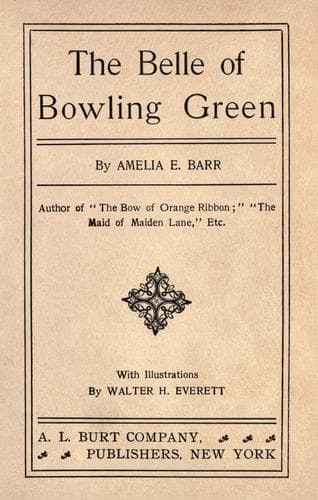
New York (N.Y.) -- Social life and customs -- 19th century -- Fiction; United States -- History -- War of 1812 -- Fiction
“In accidentals, yes, very much changed; but the large sunny rooms and
the grand seaward outlook are the same. I went first to the nursery on
the top story, and, Carlita, I could replace every chair and table. I
could see James and Leonard and Auguste busy with their books and
playthings; and there was one back window that had a little embrasure,
which was very dear and familiar to me. In that nook I read ‘Robinson
Crusoe,’ and the ‘Exiles of Siberia,’ and best of all, ‘The Arabian
Nights.’ I sat down there and tried to recall the long, long, happy days
in which it was my favourite retreat. I stood and looked downward over
the balustrade, and fancied I saw again my beautiful mother, clothed in
white and sparkling with gems, going out with father to some dinner or
ball; and I remembered how I used to thus watch for her coming, and call
her; and how she would stand still and lift her face full of love and
smiles to bid me a ‘good-night.’ Once at a little ceremony of this kind
I dropped her a white rose, and she put it in her bosom, and my father
laughed and called me ‘darling’ and I went to bed that night more happy
than I can tell you. I stayed some time in the nursery, and longer in my
mother’s room. It had only sweet memories, for I never went into it
without meeting a smile, no, not even on that last day of her beautiful
life, when she called us all to her side for the long farewell. She
died, as I have often told you, singing. She had sung, more or less, all
her life long; and she went away faintly and sweetly singing,
“‘Hark, they whisper, angels say,
Sister spirit, come away;’
and after a pause, still more softly--
“‘Tell me, my soul, can this be death?’
See, Carlita, I brought some sprays from the honeysuckle she planted on
the seaward porch. Though November, it is in bloom. My father put
flowers from this same vine in her hands after she was dead. It was a
lovely, happy memory, Carlita. In a little sitting-room I found a window
pane on which Annette St. Ange and my mother had written their names,
enclosing them in a very perfect circle, and I brought the glass away
with me. I could not bear to think that some stranger, in the
destruction of the room, might perhaps tread the names beneath his
feet.”
“Grandmother must have loved Mrs. St. Ange?”
“They were close friends, especially after the disappearance of Mr. St.
Agne.”
“Mother, what was the meaning of that disappearance--death?”
“People generally spoke of it as death; but my father and mother knew
better; and when Annette had passed beyond mortal care and suffering
something occurred--I think the marriage of her granddaughter in
Paris--that led my mother to tell me the truth. To-day, Carlita, I saw
Annette St. Ange again, though not as I recollected her in life.”
“What do you mean, mother?”
“I saw her picture; the one taken soon after her marriage, and in her
marriage garments--I was at the Loan Exhibition.”
Public-domain text, read in full here on John Shaqi.
Reviews
Reviews
No reviews yet
Be the first to share your thoughts on this work.
Elsewhere in the archive
Join the Discussion
Join the discussion
Sign in to leave a comment or review.
Sign InorCreate an account