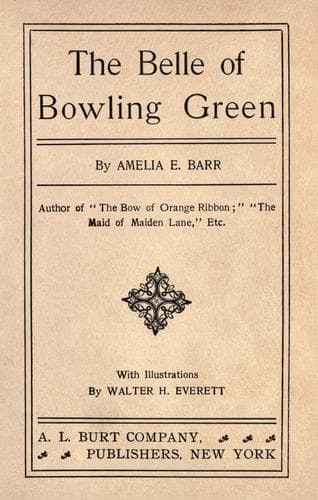
New York (N.Y.) -- Social life and customs -- 19th century -- Fiction; United States -- History -- War of 1812 -- Fiction
“Oh, mother, why did you not wait for me to go with you?”
“Well, my dear, the bit of glass in my hand made me remember the
exhibit; and as I had heard Gerard say the Van Sants were going to send
some portraits, I suddenly resolved to visit the rooms and see if
Annette St. Ange’s was among them. And there I saw it--very
conspicuously placed also; a wonderfully lovely presentment of a lovely
girl.”
“But was it like her?”
“It was not like the Mrs. St. Ange I remember. The portrait represented
a fairylike beauty, dainty, exquisite, with the bluest eyes and the
palest golden hair imaginable; an air of indefinable coquetry and grace;
and a slight, girlish figure clothed in white from head to feet. But the
Mrs. St. Ange that used to visit my mother was very different. She was
always in black, her eyes were not pretty or expressive, her hair had
lost all its glow, and her slight figure became round and heavy. She was
also sad-looking. I do not recollect her smiling. She seemed full of
care. Still there were points of resemblance, when you looked for them;
and you may be sure the bright, lovely girl did not become the sad,
hard-looking woman without many and long-continued trials.”
“She ought not to have married a foreigner. They do not understand
American women; and then one or the other goes to the wall.”
“In the St. Ange case, it was Annette. Her husband was soft as velvet
and hard as iron. In some way she lost her grip of the situation, and
when men go one step beyond their right they go too far. He never said
an impolite word to her; also, he ceased saying a loving word. She
became afraid of him, nervous, diffident, and suspicious. He had only to
remark in the blandest way that she was losing her fine manners, and she
lost them. In his presence she did herself no justice. He looked
critically at her, slightly shrugged his shoulders, and she was as
awkward as he considered her. In five years no one would have known the
once sarcastic, clever, authoritative Annette de Vries. She had
subsided. She was forgotten; and she hardly knew how to frame a
complaint of the way in which this condition had been brought about.
“Fortunately, she found some comfort in her house and her children, but
Mr. St. Ange took no apparent interest in either. It was a lonely
pleasure. He was disappointed because the three girls were not three
boys. He spent very little time in his home, preferring one or other of
the clubs of which he was a member.”
“I think he was simply--a brute.”
Public-domain text, read in full here on John Shaqi.
Reviews
Reviews
No reviews yet
Be the first to share your thoughts on this work.
Elsewhere in the archive
Join the Discussion
Join the discussion
Sign in to leave a comment or review.
Sign InorCreate an account