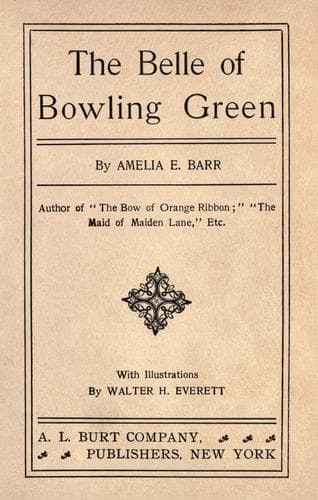
New York (N.Y.) -- Social life and customs -- 19th century -- Fiction; United States -- History -- War of 1812 -- Fiction
Carlita laughed scornfully, and her mother continued: “Annette took the
information with a blank calmness; no one could tell what her feelings
were. She continued her busy life for three more years, and then one day
a fashionable gentleman, called Van Tienhoven, visited her. In the most
guarded and respectful manner he told her that he had just returned from
France; that while there he had, through the influence of powerful
friends, visited the Court of Versailles several times, and that on two
occasions he had seen there, in close attendance upon the King, Mr. St.
Ange, or, he added, if not Mr. St. Ange, the most perfect duplicate of
that gentleman that can be imagined. Annette preserved her composure
until his confidence was closed, then gave it an unqualified denial. She
told Van Tienhoven that St. Ange’s lawyer had assured her of the death
of her husband; and begged him not to give publicity to the suspicion
that he still lived. She showed him how painful it must be to her, how
unfortunate for her daughters, and she emphatically declared her own
belief in Mr. St. Ange’s death. He gave her his word of honour to
observe strict silence on the subject; and the Van Tienhovens are all
gentlemen. I have no doubt the promise of secrecy was kept.
“But Annette became restless and unhappy, and both her grandmother and
my father advised her to go to Paris. She went, taking with her Jonaca,
the eldest of her daughters, who had always been the favourite of St.
Ange. In less than four months she was in New York again. She came back
without Jonaca, and dressed in the most pronounced widow’s costume. She
said unequivocally that her husband was dead, and that she had left
Jonaca at a fine Parisian school; her father’s friends having strongly
urged her to do so, promising to care well for the girl. No one had any
right to doubt Annette’s statement, but mother told me that from the
first there was a doubt. It was undefined and unspoken, but it permeated
society; and Annette soon felt it. One day after some particularly
disagreeable incident, she came to my mother and told her what had
occurred; and mother said, ‘Dear, what does it matter? _You_ know that
Achille is dead, do you not?’ And she answered in a sullen, angry way,
‘Sapphira, he is as dead to me as if he lay at the bottom of the Bay of
Biscay. There is no truer widow in all America than Annette St. Ange.
And then she pulled the widow’s veil from her bonnet, and the widow’s
cap from her head, and flung them with passionate scorn far from her.
What confidence followed this act mother never fully told me; but I
gathered from what she said that she had been compelled to give up
Jonaca, who had been placed in a convent for proper education, and that
the interview with her husband had been extremely painful. But he kissed
her hand at the close of the negotiations, and he sent servants in
magnificent livery to attend to her luggage and passports and all the
Public-domain text, read in full here on John Shaqi.
Reviews
Reviews
No reviews yet
Be the first to share your thoughts on this work.
Elsewhere in the archive
Join the Discussion
Join the discussion
Sign in to leave a comment or review.
Sign InorCreate an account