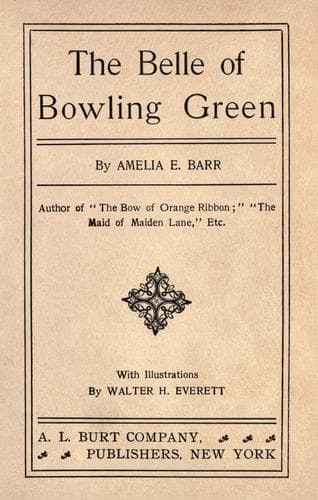
New York (N.Y.) -- Social life and customs -- 19th century -- Fiction; United States -- History -- War of 1812 -- Fiction
other formalities of travel; and they waited on her as if she was a
princess, until they saw her safely on board the American-bound vessel.
“Gradually I learned more of this domestic tragedy. Judge Bloommaert
told my father and mother that Annette was in receipt of a large income
from France. Later, I heard that the notes authenticating this income
were signed by the Duc de Massareene. A few years later Jonaca St. Ange
was introduced to French society of the highest rank, and in about half
a year we heard of her marriage to the Marquis de Lauvine. Annette was
proud of the alliance, and announced it in all the New York newspapers.”
“Now, mother, I begin to see how it is all the Van Sants go to Paris
‘for their luck,’ as they say.”
“You see only in part. Annette never spoke plainly to any one, unless it
was to my mother and her lawyer. Her second daughter, Clara, went to
Paris in her fifteenth year, remained in the convent two years, and was
then introduced to society by her sister, the Marquise de Lauvine. But
Clara refused all French alliances; she had a child love for George Van
Sant, and she came home and married him. The youngest daughter, Annette,
also went to Paris, and returned home to marry Fayette Varian. Their
children have all friends in Paris, and some Americans wonder at the way
they succeed socially. To me it is no wonder. The de Massareenes and De
Lauvines are sensible of their right, and rather proud of their rich
American kindred.”
“I understand now, mother, why the Van Sants and Varians still crown
Annette St. Ange as the most remarkable of women.”
“She was a remarkable woman. My father did not hesitate to say to my
mother and self, that she had done wisely in accepting money in place of
a very doubtful recognition. You see the marriage laws were uncertain to
her, and she knew well if her husband was a Roman Catholic that
circumstance alone might invalidate her own marriage.”
“But was he a Roman Catholic?”
“Yes. Always had been, I suspect.”
“Then I think he was very dishonourable, and----”
Public-domain text, read in full here on John Shaqi.
Reviews
Reviews
No reviews yet
Be the first to share your thoughts on this work.
Elsewhere in the archive
Join the Discussion
Join the discussion
Sign in to leave a comment or review.
Sign InorCreate an account