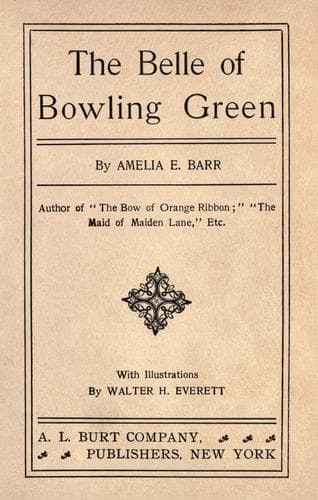
New York (N.Y.) -- Social life and customs -- 19th century -- Fiction; United States -- History -- War of 1812 -- Fiction
“I do not doubt your faith, Carlita; and you must remember, I am now
giving you instances of good results from your grandfather’s wandering
fever. For you know wherever he went the lust for land went with him.
He had also the strangest instinct concerning its value. In some occult
way he divined the fortune of land, just as some fishermen point out to
the fleet of boats exactly where the school of herring swim, though no
ripple on the water and no shimmer of the fish show to the ordinary
eye--or, as I myself have seen, a man step out from his comrades and say
‘You may dig here, there is water beneath our feet.’ In some such way,
your grandfather could pick out the corners of certain streets, and even
plots and parcels of unplanted lands, as future desirable locations.”
“I do wish, mother, such an instinct was hereditary, and that it had
come my road.”
“It was a special gift, and perhaps was allied to the second-sight that
was not uncommon among his people. I was going to tell you that about
1850 he went to New Orleans. He had property there, and always kept it,
my mother thought, because it gave him a plausible excuse for a journey
when he could find no other. Well, on this journey he met, in New
Orleans, General Sam Houston. The two men loved each other on sight, and
your grandfather went back with him to Texas. He was infatuated with the
country. He wrote mother the most extravagant love letters, all inspired
by the skies, and the prairies, the wonderful sunshine, the intoxicating
atmosphere, and the seas of flowers nodding, even at his bridle reins.
And my dear mother affected an equal enthusiasm; she told him to enjoy
the trip in all its fulness--not to hurry home. She assured him all was
well--and that she was able to manage affairs a little longer without
him.”
“I suppose she knew that he would stay until the fever of wandering had
exhausted itself?”
“Perhaps she did; but even if so, her sympathy made him more happy. He
remained in Texas nearly a year, and, of course, bought land there. Some
of this land has been very advantageously turned into cash; but there
was one tract he would never part with. To be sure, no one seemed to
want it; and I have heard Texans who came to our house--where they were
always welcome--ask him what motive he had in buying land so valueless.
He always laughed a little, and said, ‘It was a fancy of his.’ Then
_they_ would laugh, and tell him that ‘he was rich enough to buy a
fancy.’ All the same, it was easy to see they thought either that my
father had been cheated or else that he was a mighty poor judge of land
and localities. But nothing altered his opinion of the Texas property,
and he took a promise both from my brothers and myself that we would not
sell it for fifty years. Well, Carlita, you know how it turned out?”
“Mother! You mean the oil lands? Good gracious! How could grandfather
know? There was no oil found below ground in his day--how could he
know?”
Public-domain text, read in full here on John Shaqi.
Reviews
Reviews
No reviews yet
Be the first to share your thoughts on this work.
Elsewhere in the archive
Join the Discussion
Join the discussion
Sign in to leave a comment or review.
Sign InorCreate an account