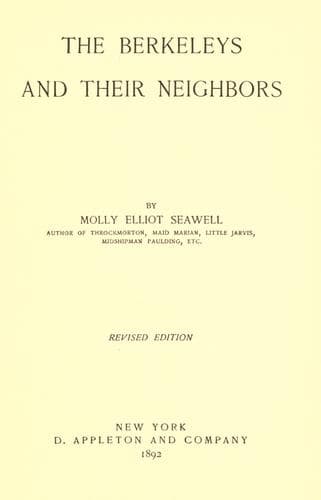
The Berkeleys and their neighborsSeawell, Molly Elliot
General
The Berkeleys and their neighbors
Seawell, Molly Elliot
Virginia -- Fiction
“But the widow--Eliza Peyton--eh, Cole? I think you have made some
headway there,” cried the Colonel, wagging his head at the little
clergyman. Mr. Cole’s heart began to thump. Strange it was that
although he ought, as a Christian and a clergyman, to disapprove of
Madame Koller with her beautiful blonde hair, he could not find it in
his heart to feel it. Nevertheless he could say it easily enough.
“I very much doubt, sir, the propriety of my visiting at The Beeches.”
“Pooh, pooh. You’ll get over it,” chuckled Colonel Berkeley.
Ah, John Chrysostom! Has it never been known that the outward man
denounced what the inward man yearned and hankered after? At this very
moment do you not remember the turn of Madame Koller’s handsome head,
and the faint perfume that exhaled from her trailing gown?
“We must invite them to dinner,” said the Colonel, decidedly. “Cole,
you must come, too. That poor devil, Ahlberg, is almost starved at the
tavern on fried chicken three times a day, and claret from the tavern
bar.”
CHAPTER III.
A ROUND of solemn afternoon dinings followed the return of the
Berkeleys to Isleham, and were scrupulously returned. But both the
Colonel and Olivia felt that it would not be well to include any of
the county gentry the day Madame Koller and Mr. Ahlberg were to dine
with them. Mr. Cole had already been invited--and Colonel Berkeley
of his own free will, without saying a word to Olivia, asked the two
Pembrokes. Olivia, when she heard of this, was intensely vexed. She
had used both sarcasm and persuasion on Pembroke in Paris to get
him home, and he had laughed at her. Yet she was firmly convinced,
as soon as Madame Koller expressed a determination to come, either
Pembroke had agreed, or else Madame Koller had followed him--in either
case Olivia was not pleased, and received the Colonel’s information
that the Pembrokes would be there sure in ominous silence. Nothing
remained but for her to show what a remarkably good dinner she could
give--and this she felt was clearly within her power. She was naturally
a clever housekeeper, and as the case often was in those days, the
freedom of the negroes had made but little difference in the ménage
at Isleham. Most of the house servants had turned squatters on the
plantation. Petrarch, unpopular among his confrères because of his
superior advantages and accomplishments as well as his assumption
of righteousness, was the major-domo--and then there was Ike, a
gingerbread colored Chesterfield, as dining-room servant.
Public-domain text, read in full here on John Shaqi.
Reviews
Reviews
No reviews yet
Be the first to share your thoughts on this work.
Join the Discussion
Join the discussion
Sign in to leave a comment or review.
Sign InorCreate an account