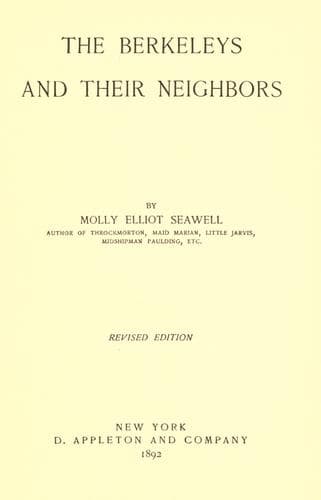
The Berkeleys and their neighborsSeawell, Molly Elliot
General
The Berkeleys and their neighbors
Seawell, Molly Elliot
Virginia -- Fiction
The people, in carriages, or on horseback, bore little resemblance
to the usual country gathering. They were gentlepeople tinged with
rusticity. All of them had good, high sounding Anglo-Saxon names. There
was some magnificence of an antique pattern. One huge family ark was
drawn by four sleek old horses, with a venerable black coachman on the
box, and inside a superb old lady with a black veil falling over her
white hair. There were but two really correct equipages in the field.
One was a trim, chocolate-colored victoria, with brown horses and a
chocolate-colored coachman to match. In it sat a showy woman, with a
profusion of dazzling blonde hair, and beside her was an immaculately
well dressed blonde man. The turnout looked like a finely finished
photograph among a lot of dingy old family portraits.
The other carriage that would have passed muster was a large and
handsome landau, respectfully called “the Isleham carriage,” and in
it sat Colonel Berkeley and his daughter Olivia. The Colonel was a
genuine Virginia colonel, and claimed to be the last man in the State
to wear a ruffled shirt bosom. A billowy expanse of thread cambric
ruffles rushed out of his waistcoat; his snow white hair was carefully
combed down upon his coat collar. At the carriage door stood his
double--an elderly negro as grizzled as his master, to whom he bore
that curious resemblance that comes of fifty years association. This
resemblance was very much increased when Colonel Berkeley’s back was
turned, and in the privacy of the kitchen, Petrarch--or more commonly
Pete--pished and pshawed and railed and swore in the colonel’s most
inimitable manner. Each, too, possessed a type of aggressive piety,
which in Colonel Berkeley took the form of a loud declaration that
a gentleman, in order to be a gentleman, must be a member of the
Episcopal Church. This once accomplished, the Colonel was willing to
allow liberally for the weaknesses of human nature, and considered
too great strictness of behavior as “deuced ungentlemanlike, begad.”
Petrarch regarded himself as a second Isaiah the prophet, and a vessel
of election--having reached the stage of perfectibility--a usual thing
in the experience of a genuine African. The Colonel described Petrarch
as “that infernal rascally boy of mine,” and this “boy” was the one
individual he had never been able to overawe or silence. Possibly an
exception might be made to this in Miss Olivia, who sitting up, slim
and straight and pretty, was treated by her father with elaborate
old-fashioned courtesy. Colonel Berkeley was in a particularly happy
and virtuous frame of mind on this day. This was his first appearance
in public since his return from Europe, where a serious bodily injury
had kept him during the whole four years of the war. He gloried in the
consciousness that he was no renegade, but had returned to the sacred
soil as soon as he possibly could, when he might have been enjoying
himself elsewhere.
Public-domain text, read in full here on John Shaqi.
Reviews
Reviews
No reviews yet
Be the first to share your thoughts on this work.
Join the Discussion
Join the discussion
Sign in to leave a comment or review.
Sign InorCreate an account