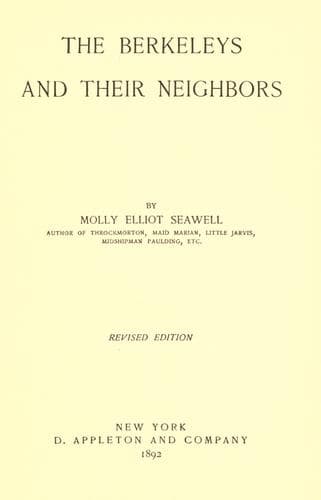
The Berkeleys and their neighborsSeawell, Molly Elliot
General
The Berkeleys and their neighbors
Seawell, Molly Elliot
Virginia -- Fiction
As for Madame Koller, she was wretched, anxious, everything but bored.
That she was not--she was too miserable. Like Ahlberg, she thought
herself almost a lunatic. Hers was not the folly of a guileless girl,
but the deep-seated and unspeakable folly of a matured woman. When
M. Koller died she had regarded herself as one of the most fortunate
women in the world. Still young, rich, pretty, what more could she
ask? The world had almost forgotten, if it ever knew, that she had had
a stage career, when stage careers were not the most desirable things
in the world. She had done her duty as well as she knew it by the dead
and gone Koller, who, in consideration of leaving her a comfortable
fortune, had made her life a torment upon earth. Just when she was
preparing to enjoy her liberty she had found herself enslaved by her
own act as it were. Sometimes she asked herself contemptuously what
Pembroke could give her if she married him, in exchange for liberty
which she prized, and answered herself with the wisdom of the world.
Again she reasoned with herself and got for answer the wildest folly
a girl of sixteen could imagine. With him was everything--without him
was nothing. And his indifference piqued her. She truly believed him
quite callous to any woman, and she had often heard him say that he
had no intention of marrying. Pembroke, returning to the life of a
country gentleman after four years’ campaigning, followed by a time of
thoughtless pleasure, mixed with the pain of defeat, of the misery of
seeing Miles forever wretched, broken in fortune, though not in spirit,
found Madame Koller’s society quite fascinating enough. But he was not
so far gone that he did not see the abyss before him. On the one hand
was money and luxury and pleasure and idleness and Madame Koller, with
her blonde hair and her studied graces and her dramatic singing--and
on the other was work and perhaps poverty, and a dull provincial
existence. But then he would be a man--and if he married Madame Koller
he would not be a man. It is no man’s part to live solely for any
woman, and nobody knew that better than French Pembroke. Of course,
he knew that he could marry her--the love-making, such as it was, had
been chiefly on the lady’s part. He was angry beyond measure with her
when she appeared upon the scene. He wished to try life without Madame
Koller. But when she came she certainly drew him often to The Beeches.
There was but one other woman in the county who really interested him.
This was Olivia Berkeley, and she was uncertain and hard to please.
It was undeniably pleasant to ride over to The Beeches on winter
afternoons and find Madame Koller in a cosy sitting room before a
wood fire, and to have her read to him and sing to him. Sometimes he
wondered how he ever came away unpledged. Again, he faintly blamed
himself for going--but if he remained away Madame Koller sent for
him and reproached him bitterly. She knew quite as much of the world
Public-domain text, read in full here on John Shaqi.
Reviews
Reviews
No reviews yet
Be the first to share your thoughts on this work.
Join the Discussion
Join the discussion
Sign in to leave a comment or review.
Sign InorCreate an account