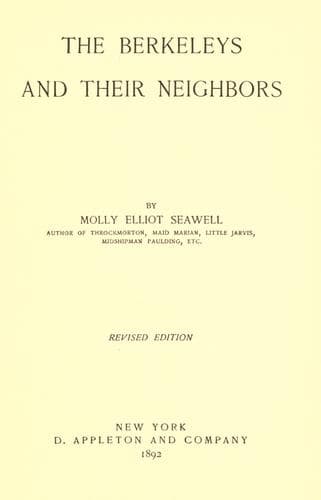
The Berkeleys and their neighborsSeawell, Molly Elliot
General
The Berkeleys and their neighbors
Seawell, Molly Elliot
Virginia -- Fiction
“I’ve--I’ve been a soldier since I saw you,” he said, with a boy’s
mixture of pride and diffidence.
“So I hear,” answered Olivia, with a pretty air of severity, “ran away
from school, I believe.”
“Yes,” said Miles, his diffidence disappearing before his pride. “I was
big enough to carry a musket. Though I wasn’t but sixteen, I was taller
than the captain of my company. Soldiering was fun until--until--.” He
began to blush furiously, but kept on after a moment. “I didn’t mind
sleeping in the mud, or anything. A man oughtn’t to mind that sort of
thing, Olivia--if you’ll let me call you Olivia.”
“Of course I will,” replied Olivia gayly. “Do you think I want to
appear any older than I am?” Then she turned to Pembroke and said, “I
was sorry not to have seen you the day you came to Isleham. We met last
in Paris.”
“I hope to see as much of Isleham as we did in the old days,” answered
Pembroke. His voice was rather remarkable, it was so clear and well
modulated.
“I hope,” began Miles, stammering a little, “that--that you and the
Colonel understood my not--why I didn’t come to see you in Paris.”
“Not fully,” answered Olivia, pleasantly. “You must come over to
Isleham and explain it--if you can. Have you seen papa yet?”
“I see him now,” said Pembroke with a smile, “shaking hands with Mrs.
Peyton.”
Olivia smiled too. There had been a flirtation between Mrs. Peyton
and Colonel Berkeley forty odd years before, and as everything that
happened in the community was perfectly well known by everybody else,
the episode had crystallized into a tradition. Colonel Berkeley had
been known to swear that Sally Peyton in her youth was a jilt. Mrs.
Peyton always said that Tom Berkeley was not to be depended on. The
Colonel was saying to Mrs. Peyton in his grandest tones:
“Madam, Time has passed you by.”
“Ah, my dear Colonel,” responded Mrs. Peyton with a quizzical look at
Colonel Berkeley’s elaborate toilet and flamboyant shirt ruffles, “we
can’t cross the dead line of sixty without showing it. Even art cannot
conceal it.”
“Just like Sally Peyton’s sharp tongue,” the colonel growled sotto
voce--while a suppressed guffaw from Pete on the verge of the group,
showed the remark was not lost on that factotum.
“And Petrarch too,” cried Mrs. Peyton in her fine, jovial old voice,
holding out her hand.
Pete shuffled up and took her hand in his black paw.
“Howdy, Miss Sally. Lordy, marster done tole de truf--you looks jes ez
young an’ chipper--How’s Mandy?”
“Mandy has lost her senses since old Abe Lincoln made you all free.
She’s left me and gone to Richmond to go to school--the old idiot.”
“Hi! I allers did like Mandy, but I ain’t got no use fer dem niggers
dat kin read ’n write. Readin’ an’ writin’ is fer white folks.”
“Shut up, you black rascal,” roared the Colonel, nevertheless highly
delighted. “Madam, may I present my daughter--Olivia, my child.”
Public-domain text, read in full here on John Shaqi.
Reviews
Reviews
No reviews yet
Be the first to share your thoughts on this work.
Join the Discussion
Join the discussion
Sign in to leave a comment or review.
Sign InorCreate an account