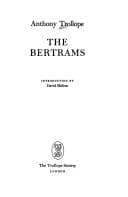
England -- Fiction; Love stories; Scholars -- Fiction
Bertram thought that Harcourt knew nothing about it, and sneered when
the successful man talked of his dark days. What darkness had his
mental eyesight ever known? We are all apt to think when our days are
dark that there is no darkness so dark as our own.
"I know what your feelings are," continued Sir Henry; "and I hope
you will forgive me if I speak openly. You have resolved not to meet
Caroline. My object is to make you put aside that resolve. It is
my object and hers also. It is out of the question that you should
continue to avoid the world. Your walk in life will be that of
a literary man: but nowadays literary men become senators and
statesmen. They have high rank, are well paid, and hold their own
boldly against men of meaner capacities. This is the career that we
both foresee for you; and in that career we both hope to be your
friends."
So spoke the great advocate with suasive eloquence--with eloquence
dangerously suasive as regarded his own happiness. But in truth this
man knew not what love meant--not that love which those two wretched
lovers understood so well. That his own wife was cold to him, cold as
ice--that he well knew. That Bertram had flung her from him because
she had been cold to him--that he believed. That he himself could
live without any passionate love--that he acknowledged. His wife was
graceful and very beautiful--all the world confessed that. And thus
Sir Henry was contented. Those honeymoon days had indeed been rather
dreary. Once or twice before that labour was over he had been almost
tempted to tell her that he had paid too high for the privilege of
pressing such an icicle to his bosom. But he had restrained himself;
and now in the blaze of the London season, passing his mornings
in courts of law and his evenings in the House of Parliament, he
flattered himself that he was a happy man.
"Come and dine with us in a quiet way the day after to-morrow," said
Sir Henry, "and then the ice will be broken." George Bertram said
that he would; and from that moment his studies were at an end.
This occurred on the Monday. The invitation was for the following
Wednesday. Sir Henry explained that from some special cause he would
be relieved from parliamentary attendance, at any rate till ten
o'clock; that at the quiet dinner there would be no other guests
except Mr. and Mrs. Stistick, and Baron Brawl, whose wife and family
were not yet in town.
"You'll like the baron," said Harcourt; "he's loud and arrogant, no
doubt; but he's not loud and arrogant about nothing, as some men are.
Stistick is a bore. Of course you know him. He's member for Peterloo,
and goes with us on condition that somebody listens to him about once
a week. But the baron will put him down."
"And Mrs. Stistick?" said George.
Public-domain text, read in full here on John Shaqi.
Reviews
Reviews
No reviews yet
Be the first to share your thoughts on this work.
Elsewhere in the archive
Join the Discussion
Join the discussion
Sign in to leave a comment or review.
Sign InorCreate an account