The Best American Humorous Short Stories — John Shaqi
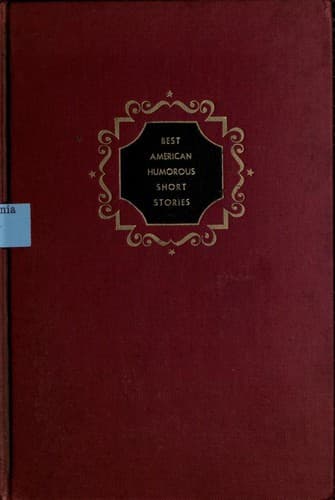
The Best American Humorous Short Stories
General
The Best American Humorous Short Stories
Short stories, American
Edward Everett Hale (1822–1909) is chiefly known as the author
of the short story, _The Man Without a Country_ (December, 1863,
_Atlantic Monthly_), but his venture in the comic vein, _My Double;
and How He Undid Me_ (September, 1859, _Atlantic Monthly_), is
equally worthy of appreciation. It was his first published story
of importance. Other noteworthy stories of his are: _The Brick
Moon_ (October, November and December, 1869, _Atlantic Monthly_),
_Life in the Brick Moon_ (February, 1870, _Atlantic Monthly_),
and _Susan’s Escort_ (May, 1890, _Harper’s Magazine_). His chief
volumes of short stories are: _The Man Without a Country, and
Other Tales_ (1868); _The Brick Moon, and Other Stories_ (1873);
_Crusoe in New York, and Other Tales_ (1880); and _Susan’s Escort,
and Others_ (1897). The stories by Hale which have made his fame
all show ability of no mean order; but they are characterized by
invention and ingenuity rather than by suffusing imagination.
There is not much homogeneity about Hale’s work. Almost any two
stories of his read as if they might have been written by different
authors. For the time being perhaps this is an advantage—his
stories charm by their novelty and individuality. In the long run,
however, this proves rather a handicap. True individuality, in
literature as in the other arts, consists not in “being different”
on different occasions—in different works—so much as in being
_samely_ different from other writers; in being _consistently_
one’s self, rather than diffusedly various selves. This does not
lessen the value of particular stories, of course. It merely
injures Hale’s fame as a whole. Perhaps some will chiefly feel not
so much that his stories are different among themselves, but that
they are not strongly anything—anybody’s—in particular, that they
lack strong personality. The pathway to fame is strewn with stray
exhibitions of talent. Apart from his purely literary productions,
Hale was one of the large moral forces of his time, through
“uplift” both in speech and the written word.
Public-domain text, read in full here on John Shaqi.
Reviews
Reviews
No reviews yet
Be the first to share your thoughts on this work.
Join the Discussion
Join the discussion
Sign in to leave a comment or review.
Sign InorCreate an account