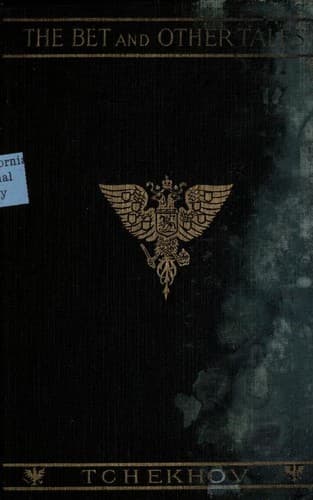
The Bet, and other storiesChekhov, Anton Pavlovich
General
The Bet, and other stories
Chekhov, Anton Pavlovich
Russian fiction -- Translations into English; Short stories, Russian -- Translations into English
THE BET
AND OTHER STORIES
BY
ANTON TCHEKHOV
TRANSLATED BY
S. KOTELIANSKY AND J. M. MURRY
JOHN W. LUCE & CO.
BOSTON
1915
TRANSLATORS’ NOTE
Stiepanovich and Stepanich are two forms of the same name,
meaning--“son of Stephen.” The abbreviated form is the more intimate
and familiar.
The Russian dishes mentioned in “A Tedious Story” have no exact
equivalents. _Sossoulki_ are a kind of little dumplings eaten in
soup; _schi_ is a soup made of sour cabbage; and _kasha_ is a kind of
porridge.
The words of the song which the students sing in “The Fit” come from
Poushkin.
CONTENTS
THE BET
A TEDIOUS STORY
THE FIT
MISFORTUNE
AFTER THE THEATRE
THAT WRETCHED BOY
ENEMIES
A TRIFLING OCCURRENCE
A GENTLEMAN FRIEND
OVERWHELMING SENSATIONS
EXPENSIVE LESSONS
A LIVING CALENDAR
OLD AGE
THE BET
I
It was a dark autumn night. The old banker was pacing from corner to
corner of his study, recalling to his mind the party he gave in the
autumn fifteen years ago. There were many clever people at the party
and much interesting conversation. They talked among other things of
capital punishment. The guests, among them not a few scholars and
journalists, for the most part disapproved of capital punishment. They
found it obsolete as a means of punishment, unfitted to a Christian
State and immoral. Some of them thought that capital punishment should
be replaced universally by life-imprisonment.
“I don’t agree with you,” said the host. “I myself have experienced
neither capital punishment nor life-imprisonment, but if one may
judge _a priori,_ then in my opinion capital punishment is more
moral and more humane than imprisonment. Execution kills instantly,
life-imprisonment kills by degrees. Who is the more humane executioner,
one who kills you in a few seconds or one who draws the life out of
you incessantly, for years?”
“They’re both equally immoral,” remarked one of the guests, “because
their purpose is the same, to take away life. The State is not God. It
has no right to take away that which it cannot give back, if it should
so desire.”
Among the company was a lawyer, a young man of about twenty-five. On
being asked his opinion, he said:
“Capital punishment and life-imprisonment are equally immoral; but if
I were offered the choice between them, I would certainly choose the
second. It’s better to live somehow than not to live at all.”
There ensued a lively discussion. The banker who was then younger and
more nervous suddenly lost his temper, banged his fist on the table, and
turning to the young lawyer, cried out:
“It’s a lie. I bet you two millions you wouldn’t stick in a cell even
for five years.”
“If that’s serious,” replied the lawyer, “then I bet I’ll stay not five
but fifteen.”
“Fifteen! Done!” cried the banker. “Gentlemen, I stake two millions.”
“Agreed. You stake two millions, I my freedom,” said the lawyer.
Public-domain text, read in full here on John Shaqi.
Reviews
Reviews
No reviews yet
Be the first to share your thoughts on this work.
Join the Discussion
Join the discussion
Sign in to leave a comment or review.
Sign InorCreate an account